As prospective students, you might be excited about the idea of university life being free and fun, but you probably also have many questions, such as, "How are classes different from high school?" and "How do students spend their days?" At university, you register for courses and create your own timetable, so daily routines vary greatly not only from faculty to faculty but also from person to person. This time, we'll introduce the timetables of first-year students in various faculties, along with course registration and recommended classes. Current students can use this as a reference for course registration, and prospective students can read it while imagining their future university life!
INDEX
▼A major difference from high school is "subject registration".
▼Here are the timetables for each faculty!
One major difference from high school is "subject registration."
At university, students create their timetables by registering for "required courses" within the credit limit set by their faculty's curriculum, as well as "elective courses" and "free courses" that match their interests and goals. This course registration must be done during the course registration period set before the start of the semester, and it is important to register only after carefully planning your course load.
Information necessary for course registration, such as course content, teaching format (in-person, online [*1], on-demand [*2]), and grading methods (attendance, quizzes, final exams, reports, etc.), can be checked in advance in the syllabus. Therefore, considering the content and workload when planning your course selection is a crucial aspect of student life. Furthermore, course registration is an important step in designing your learning, as you can also choose courses with a minor or qualification acquisition in mind. In addition, the fact that class time is 100 minutes is a significant difference from high school.
*1 A class format delivered in real time at a set time.
*2 A learning format in which pre-recorded lectures are delivered via the internet, allowing students to study according to their own schedule.
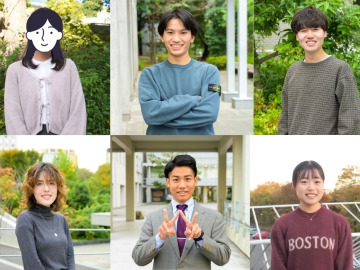
My impressions of registering for courses as a Waseda University student reader monitor for "Waseda Weekly"
1st year, School of Humanities and Social Sciences
Being able to choose the classes I take based on my interests has boosted my motivation to study!
1st year, School of Commerce
It's fun to create your own schedule, and it's interesting to compare it with others' schedules, as they differ even within the same department and year.

Class times at Waseda University
Here are the timetables for each faculty!
How do upperclassmen register for courses, and what are their daily schedules like? The format varies greatly, with some faculties having many required courses and others offering on-demand classes. While most faculties have many required courses for first-year students, and flexibility increases as you progress through the years, comparing the differences reveals the unique learning styles and characteristics of each faculty. This time, we asked upperclassmen from each faculty to share their first-year schedules!
School of Political Science and Economics
2nd year student, Chikara Wada

A quarter is a system that divides the academic year into four periods. The spring semester consists of a spring quarter and a summer quarter, and the fall semester consists of a fall quarter and a winter quarter. Some courses last for a full semester, while others are completed within a single quarter. *Click to enlarge
In the spring semester of my first year, required courses alone could fill up to 20 credits, so I made sure not to take any other classes. Also, there were several on-demand courses in the spring semester, and if I wasn't careful, I could miss the deadlines for lecture videos and quizzes, so I struggled to create a schedule and routine of which classes to watch on which days. The class I was glad I took was Spanish, which was a small class and made it easy to make friends. During my free periods, I spent time with friends in the lounge of Building 3 on Waseda Campus, working on assignments or chatting.
School of Law
3rd year student: Suhon Kanai

*Click to enlarge
The most important thing when registering for courses is to choose courses that align with your interests. When registration time comes, rumors of "easy courses" (courses where you can easily get credits) spread all over campus, but in the end, the courses that I found enjoyable and whose content I found satisfying were the easiest to get credits in. I read the syllabus carefully, checking the course content and whether the evaluation criteria were exams or reports before registering for courses. Also, taking the course "Changes in the External Environment and Corporate Dynamics," offered by School of Education, and hearing from top executives of major companies such as Tokyu Corporation was very refreshing!
School of Humanities and Social Sciences / School of Culture, Media and Society
Faculty of Letters, Arts and Sciences The faculties of School of Humanities and Social Sciences and School of Culture, Media and Society are located at and . During the first year, students take classes across faculties or jointly with two faculties. In this issue, we will introduce the timetable of School of Humanities and Social Sciences.
Kumi Imaeda, 2nd year student, School of Humanities and Social Sciences

*Click to enlarge
A distinctive feature of this program is the four weekly introductory foreign language classes where you can choose the language you want to learn. The pace of the classes is fast, and the content becomes increasingly advanced, so it's important to review regularly! When registering for courses, I made sure to choose a balance so that the grading method wasn't solely based on exams or reports. Also, since I wanted to advance to the Theater and Film course in my second year, I took film classes. The class I enjoyed the most was "Children's Culture Studies." I was able to relate it to my own childhood experiences, and it left a lasting impression on me.
School of Education
School of Education consists of four humanities disciplines: Education, Japanese Language and Literature, English Language and Literature, and Social Studies; two science disciplines: Science and Mathematics; and an Intercultural Studies discipline. The subjects you register for differ depending on the discipline. This time, we will introduce the timetable for the English Language and Literature department.
Itsuki Sunada, 2nd year student, Department of English Language and Literature, School of Education

*Click to enlarge
Since I'm taking teacher training courses, I first incorporated required subjects and subjects necessary for teaching. When registering for courses, I made sure to minimize the number of free periods and to check the evaluation methods for each class. After actually taking the classes, I realized that it was difficult to maintain motivation for subjects I wasn't interested in, so I felt that I shouldn't choose them lightly even if they're said to be "easy credits." One class I was glad I took was "Gender Studies (Using Everyday Things as a Perspective)," where I learned about the relationship between everyday life and gender through group work, and I think it broadened my perspective on things.
School of Commerce
2nd year student: Yuichiro Terui

*Click to enlarge
In my first year, I had required courses that filled my schedule from Monday to Saturday. Many seminars require students to have taken elective courses as a condition for joining, so if you've decided which seminar field you want to join or what you want to study in your faculty, taking these courses in your first year is a good idea because it allows you to learn the basics early on without feeling rushed in your second year. In my free time, I participated in student club activities at Waseda University Student Center on Toyama Campus.
School of Fundamental Science and Engineering
Of the three faculties—the Faculty of School of Fundamental Science and Engineering, the Faculty of School of Creative Science and Engineering, and the Faculty of School of Advanced Science and Engineering—this time we will introduce the timetable for the Faculty of School of Fundamental Science and Engineering.
Yotaro Tsutsumi, 2nd year student, Department of Mathematics School of Fundamental Science and Engineering

*Click to enlarge
As a first-year student, I had many required courses, including year-long courses, making it difficult to retake them in my second year and beyond. Therefore, I tried to choose courses that wouldn't overwhelm me. The classes were mainly mathematics and more difficult than in high school, so if I stumbled even once, it was hard to catch up. As a result, I regret not consulting with teachers and friends earlier when I didn't understand something. One interesting class was "Outlook on Mathematical Sciences." I was able to learn about the research outlines of professors from the Department of Mathematics and the Department of Applied Mathematics in an easy-to-understand way for first-year undergraduate students, which was a good opportunity to get an idea of what to expect in my future studies. Also, the Basic Science and Engineering Experiments were very challenging until I got used to them, as some experiments had many assignments and the class time was long. On the other hand, since we worked in different pairs for each experiment, it was also a good opportunity to broaden my social circle.
School of Social Sciences
2nd year student: Reina Kamei

*Click to enlarge
In the spring semester of my first year, there were many required courses, so I chose to take two other courses that I was interested in: "Human Geography" and "Introduction to Marketing." I think prioritizing courses that interested me helped me maintain my motivation to attend university. On the other hand, because the university is far from my home, having days with only one class made commuting very burdensome and inefficient. When creating my timetable, I realized I should have grouped more classes together each day, and I'm being more careful about that in the next semester.
School of Human Sciences
2nd year student: Sumika Dasai

*Click to enlarge
In addition to required courses, I took the maximum number of credits, focusing on classes to obtain the Class 1 Health and Safety Manager (national qualification) and Social Researcher qualifications. On Mondays and Thursdays, after attending classes at Tokorozawa Campus during the second period, I moved to Toyama Campus and worked as a student staff member at Student Affairs Section. My recommended class is "Leadership Development," a course offered by the Global Education Center (GEC) that students from any faculty can take. It was such a wonderful class that I'm involved in its operation in the 2026 academic year! If you become a Waseda student, it would be a real shame not to take this class! With the motto "Creating learning together," you can learn about leadership that everyone can utilize in a fun and serious way. You're sure to meet lifelong friends.
School of Sport Sciences
2nd year student: Saho Suzuki

*Click to enlarge
To meet the required number of credits for graduation specified for each subject group, I roughly calculated how many credits I needed to take in each subject per year and registered for courses accordingly. I ended up with a lot more free time between classes, but I was able to use that time to work on assignments with friends or have an early lunch at the school cafeteria, which was great! Volleyball in "Sports Method Practice" was a great opportunity to make many new friends. Also, "Advertising Theory" was very interesting because I gained new insights by analyzing advertisements that I usually see without thinking about them.
School of International Liberal Studies
2nd year student: Kazuki Inotsume

*Click to enlarge
School of International Liberal Studies has very few required courses, only one credit per course, so I planned my course load to be manageable over four years, taking into account my study abroad period. Specifically, I registered for many elective courses, such as the "First Year Seminar," to earn credits early. However, I ended up taking courses with content and evaluation criteria different from what I had anticipated, and I regret not having read the syllabus more carefully when registering for courses. In the "Political and Economic Situations in Southern African Countries" course, diplomats and consulate officials from Southern African countries visited the university, allowing me to gain a deeper understanding of those countries. This was particularly interesting to me because I aspire to work in international organizations or similar organizations in the future, supporting developing countries.
In Waseda Weekly, we introduce unique classes and seminars in our "What Kind of Classes Are There? What Kind of Seminars Are There?" section, so please be sure to check it out. We also post videos on Instagram that give you a glimpse into a typical day for a Waseda student. Watch them to get a better idea of what university life is like!
![[Save version] Map of the four main campuses](https://www.waseda.jp/inst/weekly/assets/uploads/2026/06/110d605cfac40346aad1d2df464a6586-940x705-1-1-610x457.jpg)