Waseda WeeklyWaseda Weekly

News

News

Waseda University student representing Toko-cam wetland conservation activities: Ensuring abundant nature for the next generation!

"Our mission is to create a connection between people and nature."

Miu Sugiura, second-year student School of Human Sciences

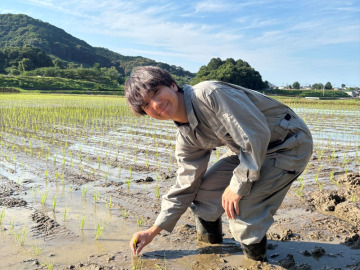
In Tokorozawa Campus Area B. Sun-dried rice in the background.

Waseda University's Tokorozawa Campus is home to an area known as Area B, which is a vast expanse of wetlands and woodland. Miu Sugiura, a second-year university student, is the representative of the Waseda University Tokorozawa Campus Area B Wetlands Conservation Activities (hereafter referred to as Wetlands Conservation Activities). In order to preserve the natural environment within Tokorozawa Campus, various events are held every month, from planting and harvesting Waseda rice to firefly viewing events, and the activities involve local residents. We spoke to Sugiura about what sparked her interest in wetlands conservation activities, how she was selected as the representative, and her future outlook.

--What first sparked your interest in wetland conservation activities?

I was born in Tokyo, but there were two rivers flowing near my house, so I was surrounded by a rich natural environment, and my family loved living things, so I've loved nature since I was a child. I even participated in a workshop where I got to experience nature at the Tama River, where I caught fish and observed the stones in the river.

In high school, I was a member of the biology club, where I worked on activities such as raising, cultivating, and preparing specimens of marine life such as flounder and devil stinger. I also had the opportunity to encounter a variety of other animals, including newts, snakes, and hedgehogs. Since I had many opportunities to come into contact with the sea in high school, I wanted to study nature from a different perspective, that of the forest, at university. Therefore, even before enrolling, I had wanted to be involved in wetland conservation activities.

This photo was taken in my high school days when I went to Enoshima with the biology club to collect marine life.

--What are wetland conservation activities?

In addition to Area A, where classrooms and baseball fields are located, Tokorozawa Campus also has Area B, a naturally rich area with a vast 3-hectare wetland and woodland. Wetland conservation activities are carried out by around 30 Waseda students, with the support of the Waseda University Natural Environmental Research Laboratory, which conducts surveys and research on the natural environment of Tokorozawa Campus. Once a month, an event is held for general students and local residents to experience the importance of diverse nature, with around 20 people participating each time.

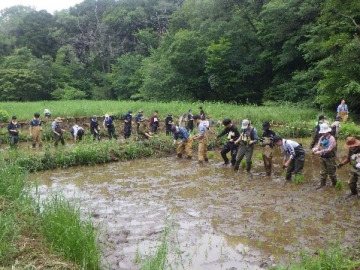
Left: Rice planting event held on May 24, 2025
Right: A bird watching event was held on February 15, 2025. Local residents and students interacted with each other while observing.

The general event schedule for the year is rice planting in May, firefly observation in July, rice harvesting in October, digging for Japanese jasmine in November, and bird watching in February. As part of the wetland conservation activities, the university is cultivating rice called "Irodori no Kizuna," a Saitama Prefecture brand rice, as part of its Waseda rice production. The rice is characterized by its strong stickiness and chewy elasticity, with a refreshing sweetness and umami flavor.

Waseda University Tokorozawa Campus Area B Wetland Conservation Activities: Planned activities for the first half of 2025 (left) and the second half (right) (click to enlarge). Events such as wetland walks, plant dyeing, and viewing of the great purple emperor butterfly are also being held.

How did you come to serve as representative?

I had always been interested in the activities of the  Natural Environmental Research Laboratory, so I contacted the staff before enrolling at university to learn more. When I actually joined, I found it more enjoyable than I expected, and before I knew it, I was participating in every activity without missing a single one. Perhaps my attitude was appreciated, because I was asked if I would like to serve as the student representative for wetland conservation activities starting in the fall semester of 2025.

My main role as representative is to coordinate all activities. Local residents of all ages, from young children to the elderly, participate in our events, so I plan staff placement and organize areas to ensure safe activities. I also act as a bridge between organizations and participants, producing promotional posters, responding to those who wish to participate in events, and introducing our activities to participants.

As I continued to participate in these activities, I felt that I was able to stand in front of others with confidence. I also felt a sense of responsibility for the important role I was playing, and my enthusiasm for the activities grew even more.

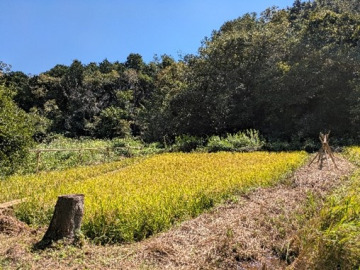
Left: Rice before harvest in October 2025. Three paddy fields are being used for rice cultivation.
Right: Rice harvesting event held in October 2025

--What is the significance of wetland conservation activities?

Wetland conservation activities can create a rich environment where a wider variety of organisms can live. A monotonous environment with only forests and grasslands results in a depleted ecosystem with only certain organisms existing. As we continued our activities, we began to notice changes in the environment of Area B. We could now observe aquatic insects, frogs, killifish, and other organisms swimming on the surface of the water, which we hadn't seen at first!

Furthermore, by interacting with nature from the perspective of the forest, I have come to realize that humans and nature support each other. At first glance, it may seem like nature is in a position to be protected by humans, but on the contrary, by protecting it, we receive benefits such as being able to harvest delicious rice and see beautiful fireflies. For this reason, I believe that creating connections between nature and people is also an important significance of wetland conservation activities.

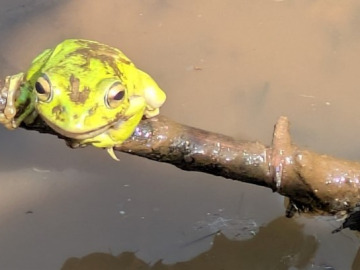
Left: A Schlegel's green tree frog in a rice paddy. Apparently, it often appears when people are working in the paddy fields.
Right: Harvested Waseda rice. Sometimes distributed to event participants.

--Please tell us about your future prospects.

In order to leave a rich natural environment for future generations, it is important to make our activities known to as many people as possible and increase the number of people who will carry them out. Our current events are dominated by participation from local residents, but we would like to attract more interest from Waseda students. It would be a waste to attend Waseda University and not experience the natural environment of Area B! Our mission is to spread the word not only to students Tokorozawa Campus, but also to students at other campuses.

To raise awareness of our activities, this year we set up a stall as an organization for the first time at Tokorozawa Campus Festival 2025. We held a plant dyeing workshop, which was attended by nearly 100 people, and we believe it was a good opportunity to raise awareness of our organization.

In order to involve even more people in my activities in the future, I would like to hone my own knowledge and skills through classes and fieldwork in wetland conservation activities.

Left: A plant dyeing workshop at Tokorozawa Campus Festival 2025. In one corner of the venue, there was also an exhibition of stuffed animals owned by Natural Environmental Research Laboratory
Right: Plant-dyed fabric. Leaves of water parsley, Houttuynia cordata, and tall fescue were collected in Area B.

916th

Interview, text and photography: Waseda Weekly Reporter (SJC student staff)
Hinari Ukiya 4th year student, School of Culture, Media and Society

Sugiura enjoying playing the electone

【profile】
Born in Tokyo. Graduated from Tokyo Metropolitan Hinodai High School. After entering university, she deepened her knowledge of forest environmental science through classes taught by Professor Motoshi Hiratsuka (Faculty of Human Sciences). Her hobby is birdwatching, and on her days off she enjoys going to the mountains to observe a variety of birds. In addition to birds, she has recently become particularly fascinated with observing the larvae of the Japanese purple emperor butterfly, the national butterfly of Japan. She started playing the electone at the age of three and continues to play it as a hobby to this day.


Waseda Weekly is the official web magazine for Waseda Student Affairs Division. It is updated every weekday during the school term! It introduces active Waseda students and graduates, student club, Waseda meal information, and more.

Page Top
WASEDA University

早稲田大学オフィシャルサイト(https://www.waseda.jp/inst/weekly/)は、以下のWebブラウザでご覧いただくことを推奨いたします。

推奨環境以外でのご利用や、推奨環境であっても設定によっては、ご利用できない場合や正しく表示されない場合がございます。より快適にご利用いただくため、お使いのブラウザを最新版に更新してご覧ください。

このままご覧いただく方は、「このまま進む」ボタンをクリックし、次ページに進んでください。

Continue

対応ブラウザについて

close