"Towards becoming a business leader who contributes to global society in the future"
Huang Tianshu, 4th year, School of Commerce
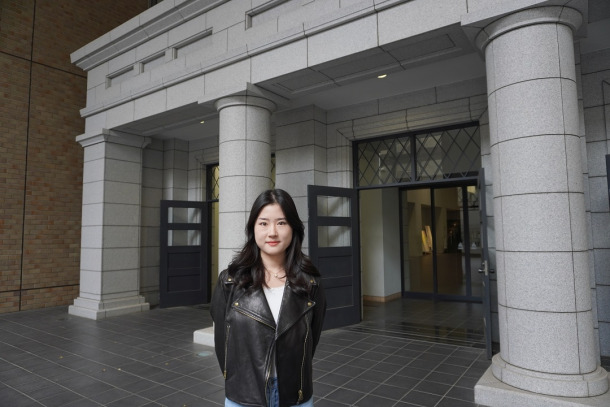
Huang, originally from China, came in second place as part of a team at BFI Case Jam 2025, an international family business competition held in Singapore in August 2025, which brought together students from around the world. Within a six-hour time limit, they worked together with peers from different countries and cultures to solve a company's challenges. Huang credits her time at the School of Commerce 's Global Management Program (GMP*), where she studied in English and engaged in discussions with students in a global environment, for supporting this experience. We spoke to Huang about what went on behind the scenes at the international competition and what she learned at GMP.
(*) A four-year undergraduate program that aims to develop "business leaders who contribute to international society." In addition to the graduation requirements common to all undergraduates, there are also completion requirements for GMP seminars, core subjects, and English proficiency.
-What kind of competition is the "BFI Case Jam 2025" ?
This is a case study competition on the theme of family businesses, hosted by the Business Families Institute (BFI) at Singapore Management University (SMU). Now in its fourth year in 2025, the competition challenges participants to derive solutions to management challenges faced by family businesses around the world within a limited time frame. Because the competition is conducted in teams, it places particular emphasis on improvisation and collaboration. On the day of the competition, over 120 students from around the world were randomly divided into approximately 30 teams and engaged in extensive discussions aimed at resolving the challenges.
Each team first competed in a preliminary round of video presentations, with the top three teams selected by the judges to advance to the finals. At the finals, we gave presentations in front of the entire audience, and the final three winners were decided.
The case presented on the day was about a Malaysian family-run agricultural company, and the question was, "How can they double their profits in the next five years?" I was nervous because we needed to collect data on Malaysian business management, but having a student from Malaysia on my team helped me out a lot. As a result, the team I was on advanced to the finals and won second place.
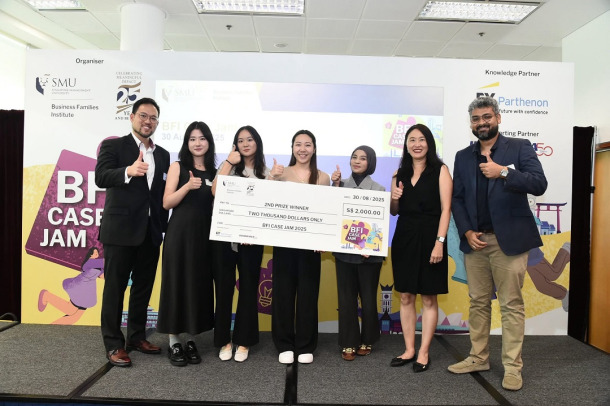
A photo of the four team members and SMU professors holding the award board (Huang is second from the left)
-Was there anything difficult about working on the project as a team?
We worked on the same case for six hours straight, so it was difficult when everyone's concentration waned or differences of opinion arose. As we worked on the case, we needed to find new markets as a measure to increase sales, but I felt that it would be difficult to grow if we only focused on Malaysia and Southeast Asia.
So, taking advantage of my Chinese background, I proposed a new strategy based on the current situation and potential of the Chinese market. However, some members of my team expressed concern that the Chinese market might be difficult. I struggled to resolve the conflicting opinions within the limited time available, but I made sure to gather as many papers, articles, and data as possible to make a well-founded proposal that would be persuasive. In the end, I was pleased that my proposal was highly evaluated for its analysis that accurately captured growth opportunities in the Chinese market, its highly feasible strategy, and the concreteness of its strategy that emphasized brand experience.
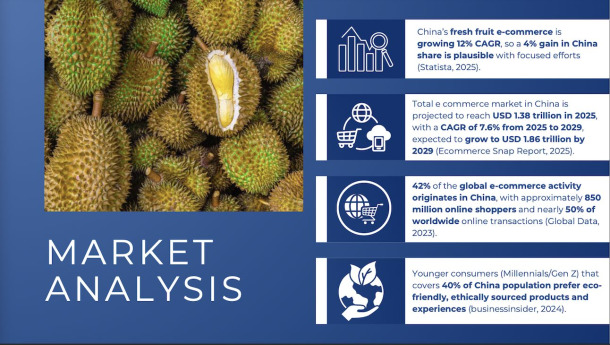

The slides used in the presentation outlined the growth potential of China's e-commerce fruit market, consumption trends among young people, and the characteristics of major competitors, and showed the expansion opportunities and direction for premium products in the Chinese market.
--What led you to study at Waseda University's School of Commerce and why did you choose GMP?
I have been studying Japanese since my first year of junior high school while living in China, and my goal was to go on to a Japanese university. Of all Japanese universities, Waseda University is the most famous in China. I myself have an international background, having come into contact with different cultures and values through living in China and studying Japanese, so I thought the School of Commerce, where I could learn in depth about global business and corporate strategy, would be the best environment for me.
I was also attracted to GMP because it has many students and international students with diverse backgrounds, many of whom want to improve their English. This year, I was able to participate in a training camp in Korea, and the abundance of opportunities to hold discussions and conduct research in other countries was another major factor in my decision to choose GMP. In this environment, a professor at GMP encouraged me to take part in an international competition, which led to my participation in the BFI Case Jam 2025.
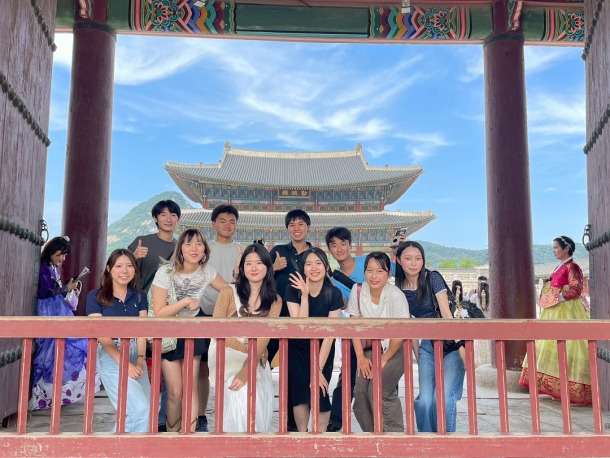
Group photo of GMP members taken at a training camp in Korea (Huang is third from the left in the front row)
-What do you learn in GMP and seminars?
I belong to Professor Jesper Carl Goeran Edman 's seminar, but he is currently away at a university in the UK for two years for research, so there are no seminar activities at the moment. It's a little lonely now that there are no third-year students in the seminar. When I was a third-year student, I was given the task of solving a real problem at a certain company, and we spent the entire semester researching that company's management strategy and diversity measures and finally presented our solution in front of the company.
At the GMP Forum, which is held once a month, students are divided into different teams each time and work on a given theme. It's very interesting to work together with a variety of members to solve problems. At the end of the forum, teams are selected as having particularly excellent solutions to make presentations on the spot and receive direct feedback from the professor. I feel that one of the great things about GMP is that you can learn problem-solving methods from a variety of perspectives in a variety of teams.
In addition, this semester we also had a Career Forum, where GMP alumni came to talk about their careers and offer advice on job hunting, making it a very appealing event for students who are thinking about job hunting.
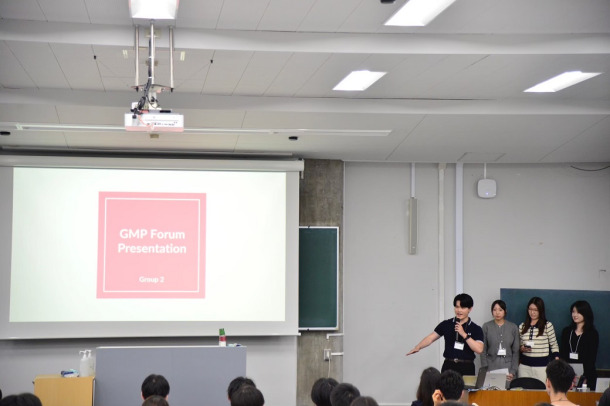
Presentation at the GMP Forum (Huang is on the far right)
--What skills do you feel you have acquired through classes in English and studying in an international environment?
I learned the importance of proactively asking lots of simple questions without being afraid, and of aligning the starting point of issues and discussion points. Because all the students have different cultural backgrounds, even if the issue is the same, it's very stimulating to see solutions that I had never thought of coming from different perspectives. I also think that Professor Edman has had a big influence. In our first seminar, he clearly pointed out things like "This part isn't good," and "You could do this part better." I was a little surprised at first, but that feedback was very refreshing, and I feel it has helped me grow as a person. I think that the frank and direct exchanges that you don't often see in Japanese classes are possible and something that is unique to an English-speaking environment.
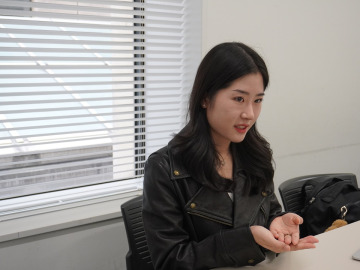
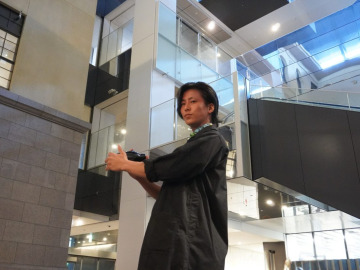
Huang responding to an interview in Building 11
--Please tell us about what you would like to challenge yourself with in the future and your goals.
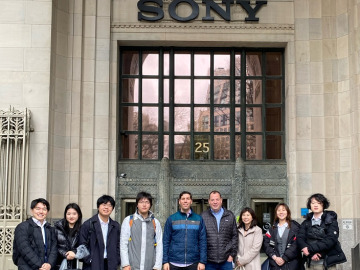
During her exchange program, she visited Sony's US headquarters in New York as part of a company visit. (Huang is second from the left.)
I am currently in the process of applying to graduate schools in the United States. I studied abroad as an exchange student in the United States from August 2024 to May 2025, but while attending classes there, I realized that I lacked a lot of knowledge and experience. Rather than starting to look for a job without yet deciding on my interests or future direction, I decided to deepen my learning and broaden my options. Through my graduate studies, I would like to acquire a way of thinking that is applicable even if I change countries or industries. My future goal is to become a "business leader who contributes to global society," which is GMP's philosophy.
915th
Interview, text, and photography: Waseda Weekly Reporter (SJC student staff)
Yuki Matsumoto, 2nd year School of Commerce
【Profile】

A photo from a TWICE concert. Her favorite is Jihyo.
Originally from China, she graduated from Nanjing Foreign Language School. Her recommended class is the core GMP course taught by Professor Kazuhiko Yago (Faculty of Commerce). Her hobby is listening to K-POP. Her favorite group is TWICE, and she sometimes goes to their concerts. Her favorite Waseda food is soup curry from Tokyo Rakkyo Brothers.

![[Save version] Map of the four main campuses](https://www.waseda.jp/inst/weekly/assets/uploads/2026/06/110d605cfac40346aad1d2df464a6586-940x705-1-1-610x457.jpg)