"I want to be a self-sustaining creator." "Participating in Monopro(the Monozukuri Program) was a great success"
Kojiro Tamayama, 4th year student, School of Creative Science and Engineering
Mone Katagiri, 4th year student, School of Creative Science and Engineering
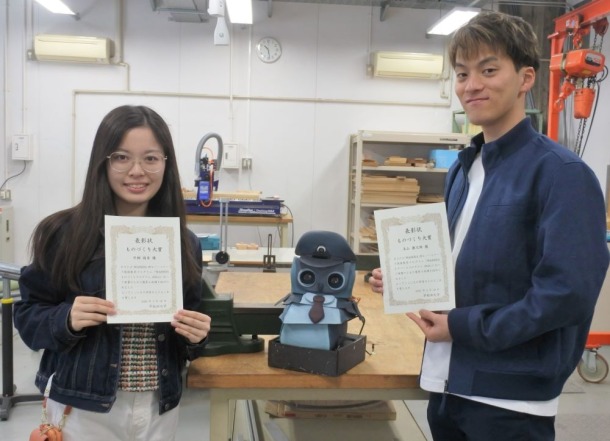
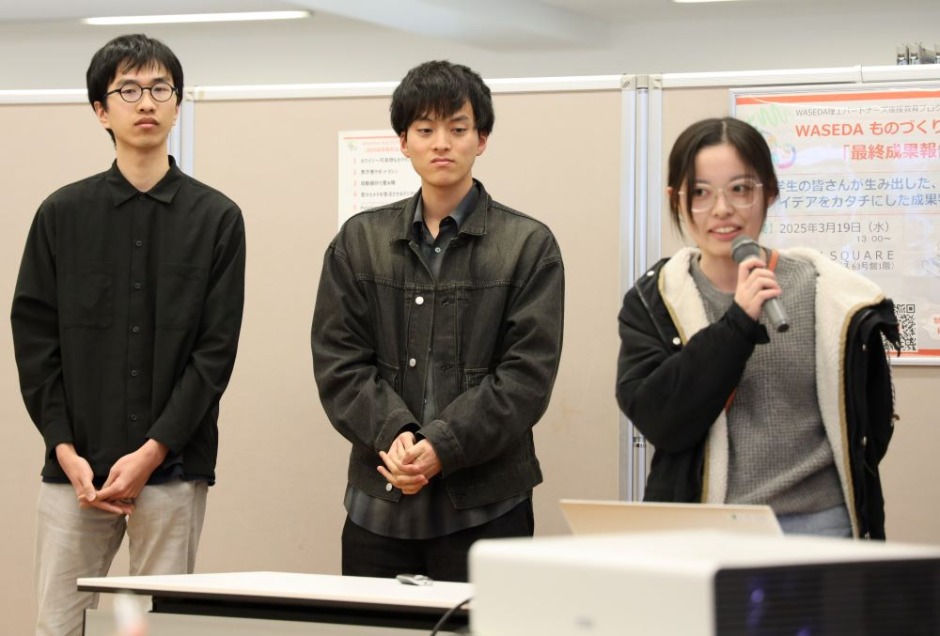
At the Waseda Manufacturing Workshop Building No. 61 Nishi-Waseda Campus. (From left: Katagiri and Tamayama)
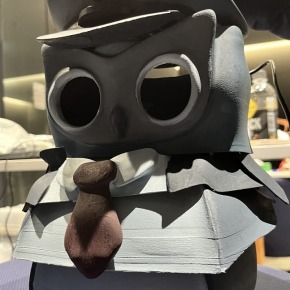
The Waseda Monozukuri Program (hereinafter referred to as Monopro ) was held annually from 2012 to 2018 with the aim of nurturing students who have the willingness to try new things and learn from failure, the ability to make plans and steadily execute them, and the ability to face difficulties. It was held for the first time in six years in June 2024, and 13 teams were selected as finalists, who challenged themselves to create original "monozukuri" (handmade items) to give shape to their ideas. The winner of the Best Monozukuri Grand Prize was "Patr-Owl," an owl-type animatronic (※1) that "watches over" people, created by Kojiro Tamayama, Mone Katagiri, and Kojiro Hayashi (4th year student. School of Creative Science and Engineering). This time, we asked Tamayama and Katagiri, representing the team, about the process of winning the grand prize and their future prospects.
(※1) A robot that depicts animals, characters, etc. as if they were alive.
How did you end up competing in Monopuro?
Tamayama: We have been involved in Waseda University ROBOSTEP (an official student club) since our first year of university, participating in Robocon and working on manufacturing. When we became third-year students and were looking for other opportunities to grow as "makers," we found a flyer posted in the manufacturing workshop and decided to participate. At that time, we called out to Katagiri.
-What made you decide to create Patr-Owl?
Tamayama: I've always loved the peaceful feel of the animatronics I often see in amusement parks. When I was feeling unmotivated and lazy, I thought it would be nice to have a robot in my home that would watch over me peacefully and motivate me.
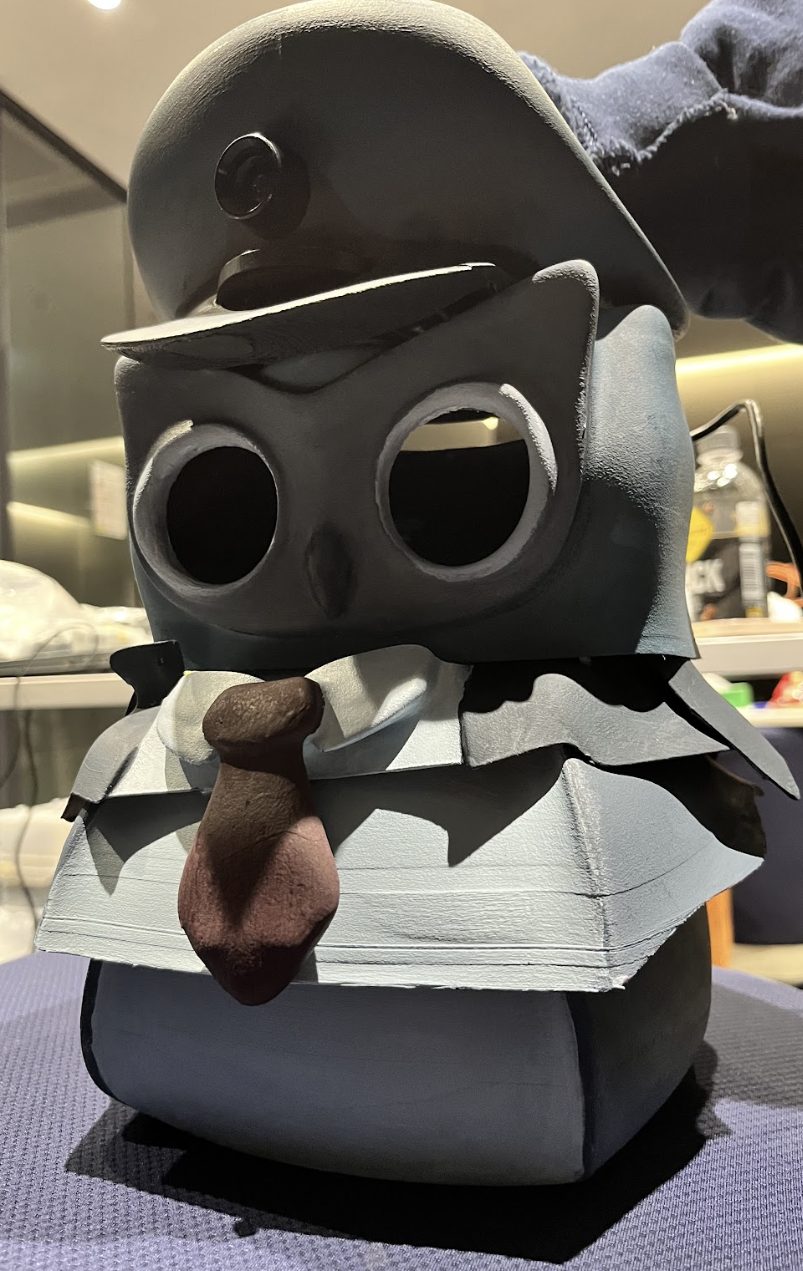
Katagiri: The phenomenon of being motivated by being watched over is related to the observer effect (*2). I thought that if we could combine the observer effect with animatronics, which are usually used for entertainment and exhibitions, it could become a form of "monitoring" that does not cause fear, as opposed to "surveillance." Since it was a form of "monitoring," we decided to create Patr-Owl, an owl-shaped robot, an animal with distinctive eyes.
(※2) A phenomenon in which a person's behavior and speech change when they feel they are being monitored by others.
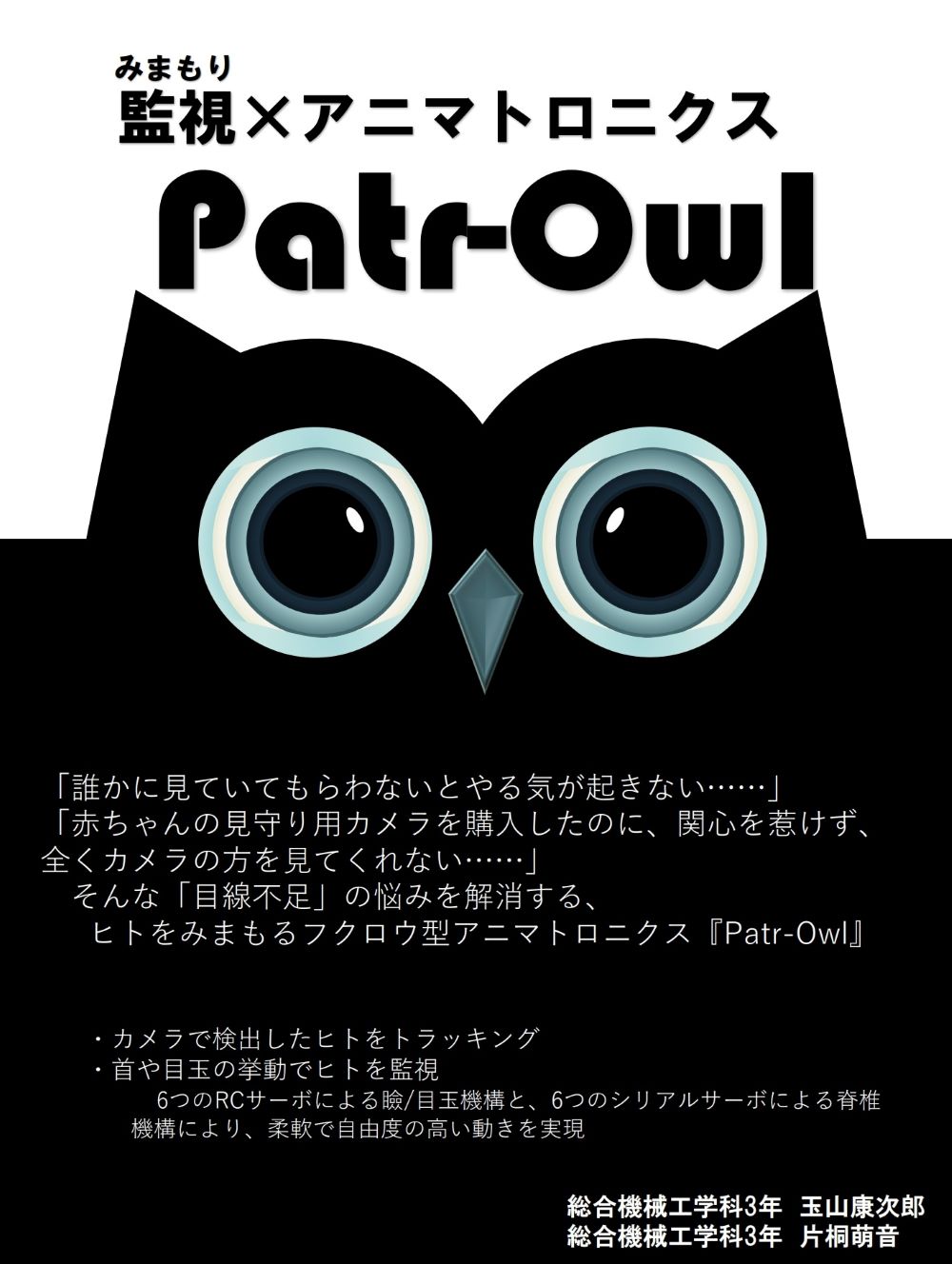
Poster presented at the Monopro final results report (Click to enlarge)
--Please tell us about how Patr-Owl works and its production process.
Katagiri: The camera built into Patr-Owl's hat recognizes a person's face and turns its eyes and body in that direction to "watch over" them. Owls have many joints in their necks, so we came up with a six-joint arm structure to reproduce their smooth movements as much as possible.
Patr-Owl turns his body towards a person
A person's face looking in a certain direction
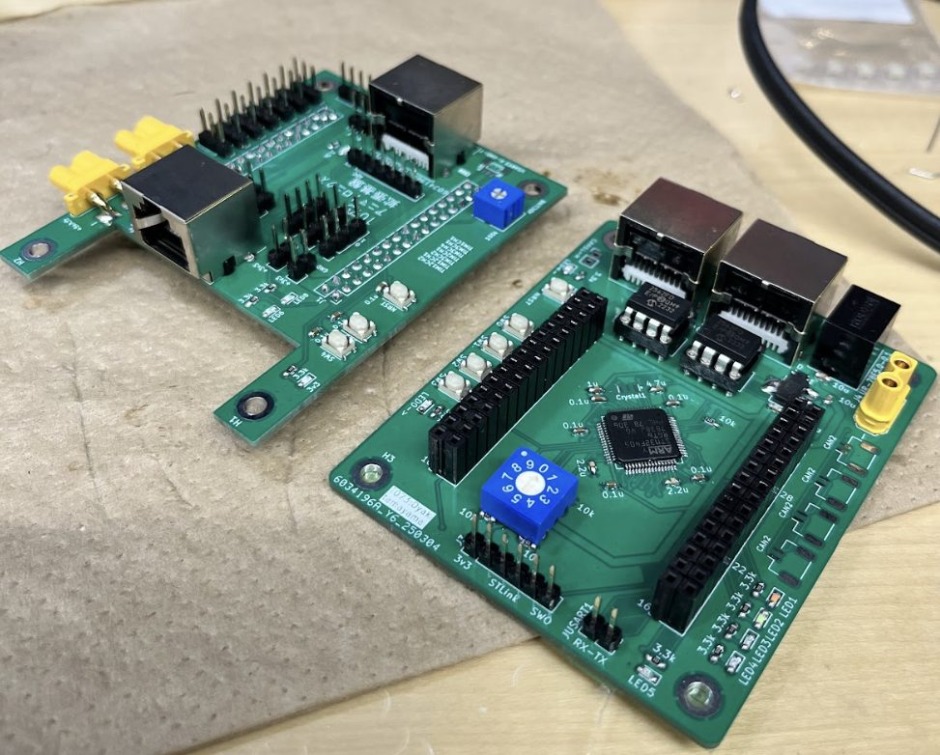
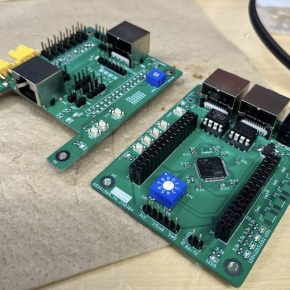
Tamayama: During the production, Katagiri was in charge of the mechanical design of the internal mechanism and the exterior and design, while I was in charge of the program that controls Patr-Owl's movements and the circuit board design. Since we were running out of time to prepare for the actual event, we asked Hayashi, who belongs to the same student club, to join us as a helper from around March, and he was mainly in charge of the part that uses the camera to recognize people's faces.
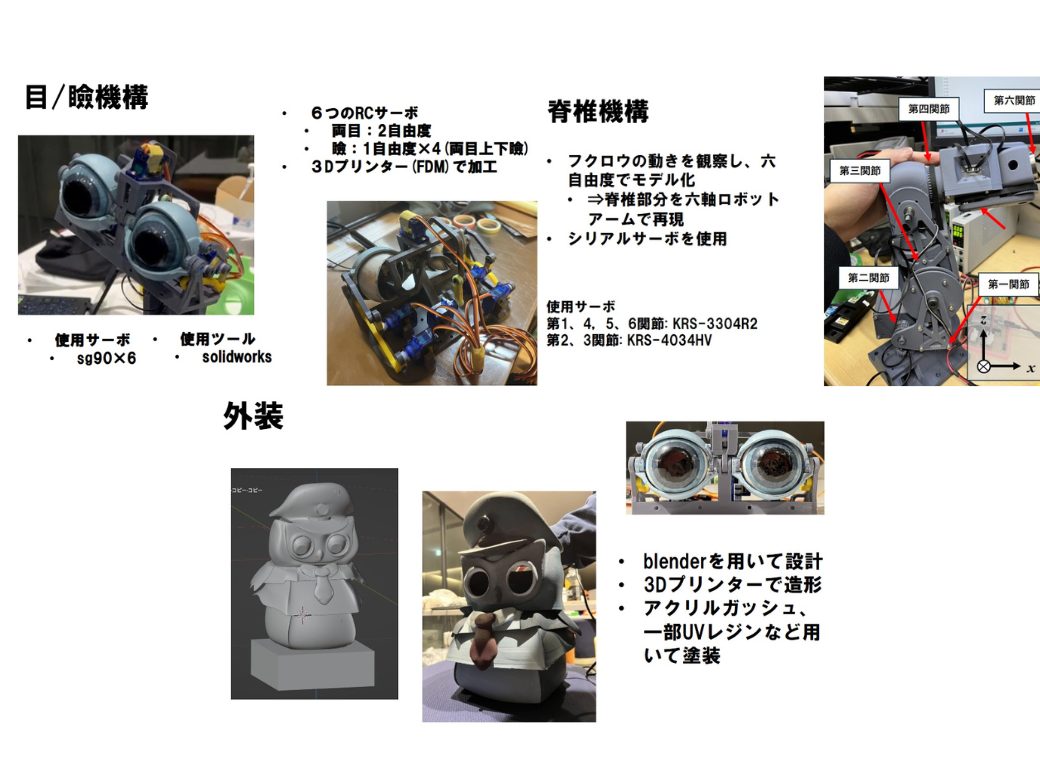
The circuit, board, internal arm mechanism, and exterior were all created from scratch. From the presentation materials (Click to enlarge)
--Have you encountered any difficulties or been able to grow through Monopro?
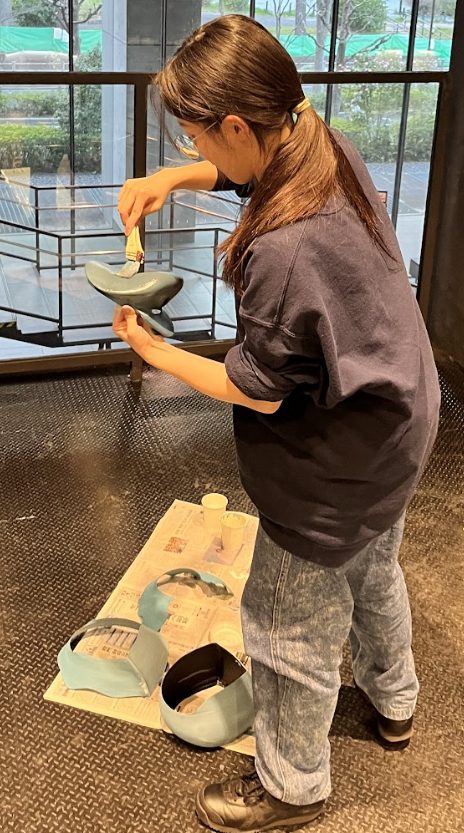
Katagiri working on the exterior of the body at Building No. 63 on Nishi-Waseda Campus.
Tamayama: From September 2024 to March 2025, we had to do everything from mechanical design to circuit design, control, and exterior production from scratch, and there were many technologies we were trying for the first time, so I think it was originally a high hurdle for two people to complete. In addition, in 2024, our schedules often did not match up, so from the end of January when the semester ended, we worked in the lounges and laboratories on Nishi-Waseda Campus every day as a final push, and soldering to the circuit board was done in the Waseda Manufacturing Workshop.
Katagiri: I continued working on the exterior after I got home, so I didn't sleep at all from about two days before the final presentation. Patr-Owl only worked satisfactorily the day before the presentation... I'm really glad I made it in time, and winning the grand prize was the result of my efforts, so I was very happy!
I feel that the experience of working hard on the robot until the very last moment and then winning the grand prize has helped me grow as a person. In previous Robocon competitions, there were times when I felt like I didn't complete my goal or I was disappointed with the results, so participating in this Monopro competition was a great success for me.
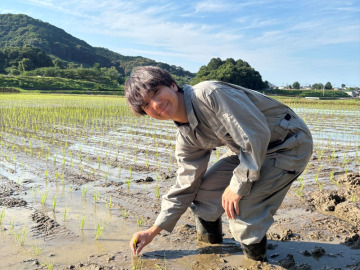
Tamayama: I'm the type of person who pursues things thoroughly, and I'm particular about "understanding the fundamentals" of anything. In robot competitions, where the speed of building tends to be valued, this way of thinking was sometimes called "unnecessary insistence" by those around me, and I was at a loss as to how to approach robot building. Despite that, I was able to stick to my own method in a short period of time, and receive the grand prize with a robot that our team was satisfied with, so I'm very pleased.
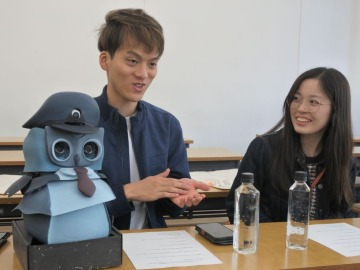
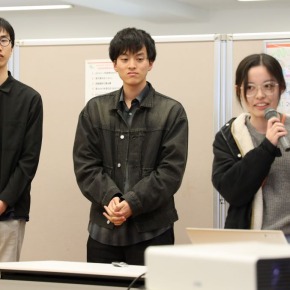
A scene from the interview. In Room 302, Building 61, Nishi-Waseda Campus.
-What are you studying at university?
Tamayama: In the laboratory of Professor Ishii Hiroyuki, which I am a part of, I am studying robots and biology and am conducting research into applying biological mechanisms to robots. I belong to the Department of Integrated Mechanical Engineering, which has many classes where we actually create things. I think that in most other universities, first and second year students only study general science education such as university mathematics and physical chemistry, but at Waseda, we have specialized subjects where we can take mechanical engineering lectures and do a lot of practical training from the first year, which I think is a real strength.
Katagiri: I belong to Professor Kiyotaka Iwasaki 's laboratory. It is an interdisciplinary laboratory that applies mechanical engineering to the medical field, and we conduct research at the Waseda University Center for Advanced Biomedical Sciences (TWIns), a joint facility with Tokyo Women's Medical University. We are currently working on research to evaluate various phenomena by creating a fluid simulator that mimics the human circulatory system (mainly the heart and blood vessels) using tubes and pumps, and simulating pathological conditions such as heart failure that are difficult to reproduce in animal experiments.
-Finally, please tell us about your future prospects.
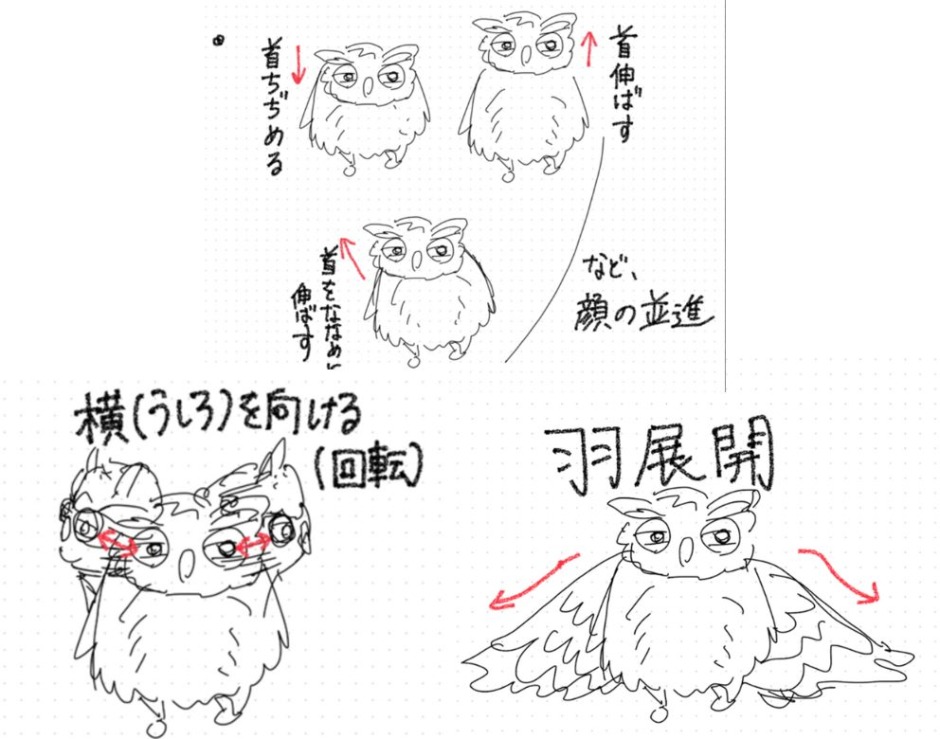
Tamayama: I want people outside the university to know about Patr-Owl, so I'm thinking of participating in Maker Faire Tokyo 2025, which will be held at Tokyo Big Sight in the fall. By then, I'd like to implement the owl movements that I wasn't able to fully realize, such as tilting my head and spreading my wings.
Personally, I would like to be a self-sustaining creator who is passionate about what I want to do and produces new things.
Katagiri: During my three years as an undergraduate, I have focused on robot production, participating in Robocon and Monopro, but from now on, I will study my field of research, biomedical engineering, to the best of my ability and work on my research. For a while, I will be doing things that are different from robot design, but I believe that there will always be a connection, so in the future, I hope to combine the knowledge and experience I have gained up to that point to create new value.
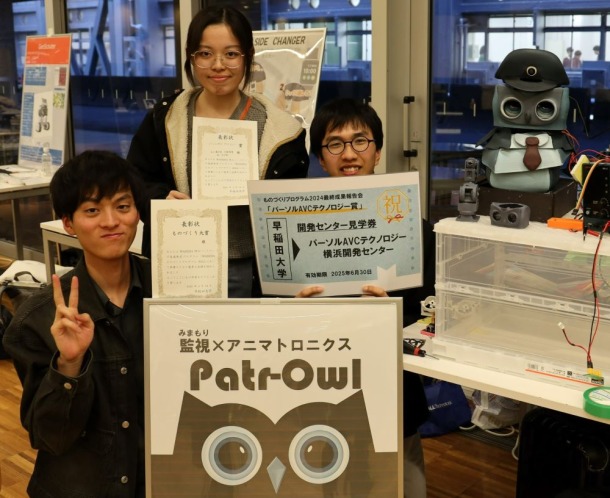
After receiving the grand prize, the team took a commemorative photo with the award certificate in hand. From the left: Tamayama, Katagiri, and Hayashi
900th
Interview, text and photography: Waseda Weekly Reporter (SJC student staff)
Rinka Nishimura, 3rd year student, School of Human Sciences
【profile】
Kojiro Tamayama: Born in Saitama Prefecture. Graduated from Saitama Prefectural Urawa High School. He likes to memorize lines from manga, and often gets ideas for making robots from manga. His recommended manga are "Attack on Titan" by Hajime Isayama (Kodansha), "Vagabond" by Takehiko Inoue (Kodansha), and "Dr. Stone" by Riichiro Inagaki (Shueisha).
Mone Katagiri: Born in Tokyo. Graduated from Hibiya High School. Loves all kinds of creative writing, and even writes short mystery novels. Recently, after taking a music programming class (a GEC course), she has been trying her hand at composing.

![[Save version] Map of the four main campuses](https://www.waseda.jp/inst/weekly/assets/uploads/2026/06/110d605cfac40346aad1d2df464a6586-940x705-1-1-610x457.jpg)