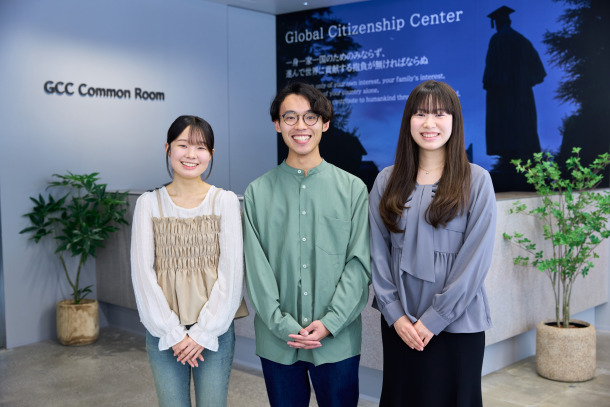
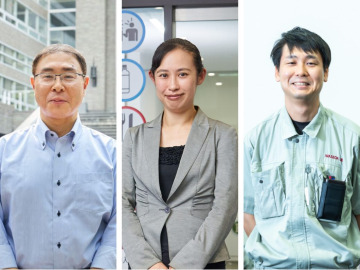
At the GCC Common Room Building 27, Waseda Campus. From left:Sugimura, Chino, and Washizu.
This community collaboration workshop involves students developing solutions to challenges faced by regions across Japan and proposing them to those communities. Waseda University students from various faculties and years of study form teams and work on their projects for approximately two months during long breaks. In addition to preliminary research and meetings, they actually visit the sites, conduct interviews with residents and local government officials, and finally present their proposals to the mayors. Unlike regular classes, this is an extracurricular activity that does not count towards graduation credits. This time, in addition to a roundtable discussion with three Waseda University students who participated in this workshop in 2024-2025, we also conducted interviews with alumni who participated in the past. We asked them about what they learned on-site and how that experience is relevant to their lives today.
INDEX
▼A community collaboration workshop for three people: Seeing, hearing, and discovering on-site
▼What I learned in the workshop is connected to my current job.
▼ "Waseda Roots Camp" - where student ideas come to life.
▼Scheduled for Summer 2026 / Regional and Corporate Collaboration Workshop
A community collaboration workshop for three people: Seeing, hearing, and discovering on-site.
Waseda University holds workshops in various regions every year. This time, we interviewed three people who participated in workshops held in Suzu (Ishikawa), Kijimadaira (Nagano), and Minamiizu (Shizuoka) about the activities and their impressions of participating.
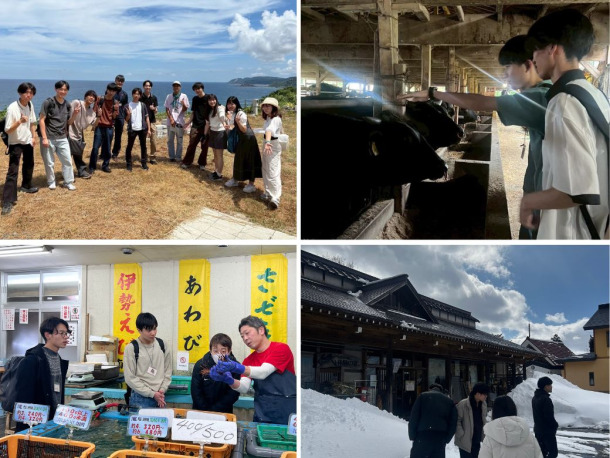
Scenes from each field survey. Clockwise from the top left: A photo of students with local government officials in Suzu, a visit to a livestock farm in Suzu, a snowy landscape in Kijimadaira, and a fish market in Minamiizu.
Suzu (Ishikawa) Workshop, Summer 2025 Participation
Rino Washizu, 2nd year student, School of Law
Kijimadaira (Nagano) Workshop, Spring 2025 Participation
Kaori Sugimura, 2nd year student, School of Culture, Media and Society
Minamiizu (Shizuoka) Workshop, Spring 2024
Minami Chino, 4th year student, School of Human Sciences
The reasons for participating in the community collaboration workshop varied from person to person.
—What prompted you to participate in the community collaboration workshop?
Sugimura: During my summer vacation, I went to Yamagata as part of a volunteer program organized by WAVOC (Waseda University The Hirayama Ikuo Volunteer Center (WAVOC)), and I had the opportunity to hear in-depth stories that I wouldn't have learned just by sightseeing. That experience made me want to participate in a community collaboration workshop next.
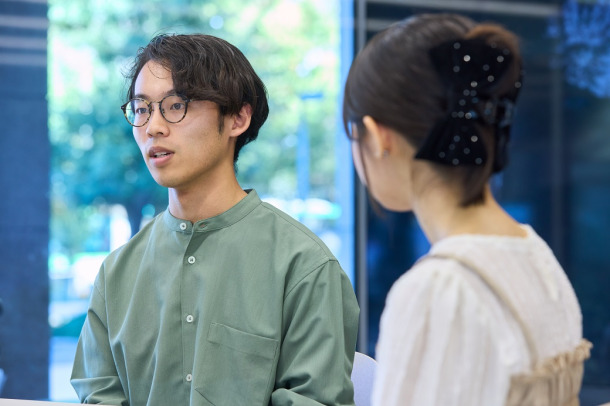
Chino
Chino: I've always been interested in local communities. However, since I was born and raised in Yamagata, I don't know much about areas outside of my hometown and Tokyo. I wanted to learn about the situation outside of my hometown, so I participated.
Washizu: I've been interested in contributing to local communities since I was in high school, and I've participated in business contests with local communities as the theme. I got into Waseda University through the entrance exam for local community research and contribution. You can research local communities online, but I thought that you can't see the real issues unless you actually go there, so that's why I participated.
You're sure to gain new insights on-site!
—What were your impressions after actually visiting the place?
Washizu: When I think of Suzu I have a strong image of the earthquake, and before going there, I thought the town's vitality might have declined. But in reality, that wasn't the case. Of course, the effects of the earthquake remain, but the city administration was also supportive of university students and entrepreneurs coming from outside and was enthusiastic about new challenges. There was a great deal of energy in the town and its people working together to revitalize the region.
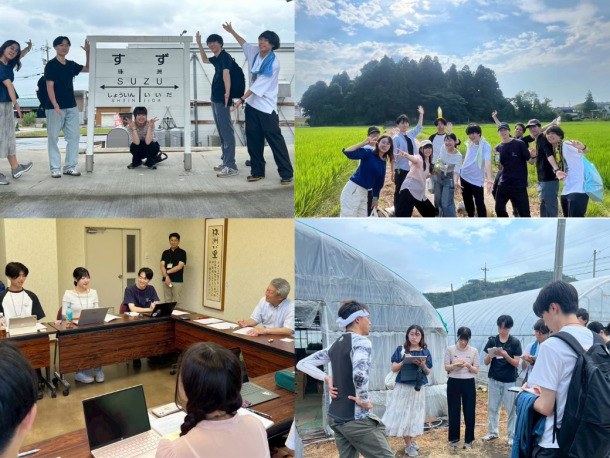
This is a field survey conducted in Suzu, in which Washizu participated. She not only interviewed local workers such as farmers (bottom right) and fishermen but also spoke with the mayor (bottom left).
Sugimura: I've been to Nagano many times in the past, but I didn't know about Kijimadaira. I had this preconceived notion that it was a small, isolated mountainous area, and I was worried about whether I would be accepted. But after talking to the residents, my preconceptions were completely overturned. They were very friendly and readily invited me to try making soba noodles and to a public viewing of the Olympics where athletes from Kijimadaira were competing.
Chino: There were so many things I couldn't understand unless I actually went there and talked to people. For example, even if someone says they want to "develop the town," what "development" means differs from person to person, and their ideas on how to develop it also differ. This diversity is something you can't see just by staying in Tokyo. Every time I learned something new about a town, my initial hypotheses were overturned.
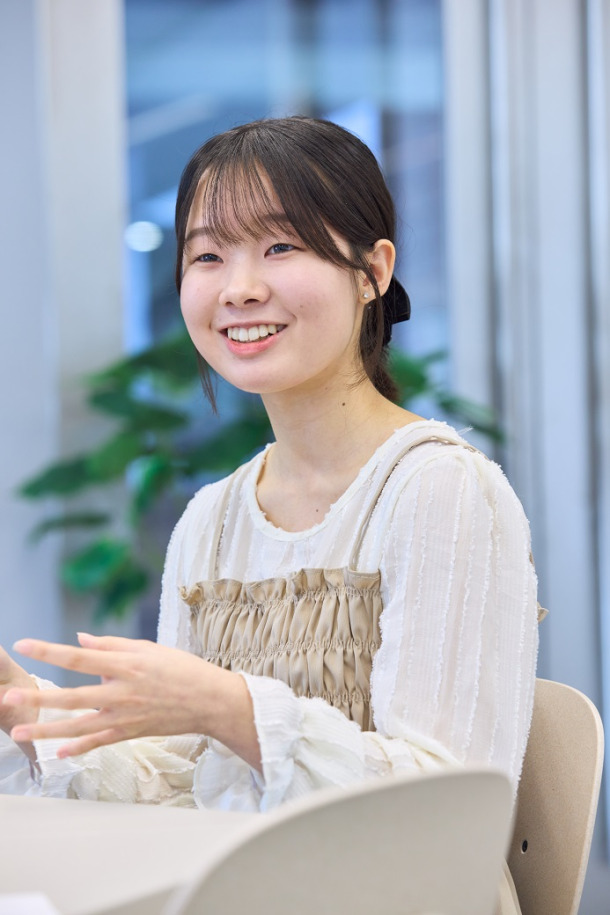
Sugimura
Sugimura: I understand! At first, I also hypothesized that there must be a labor shortage because the population is declining. But when I conducted interviews, an unexpected problem emerged: there is a shortage of machinery for buckwheat cultivation, rather than manpower. My preconceptions were gradually shattered.
Washizu: People who get involved with a region from outside are called "related population." Suzu is facing a shortage of workers in primary industries, so we hypothesized that the related population could play an active role in the form of agricultural volunteers. However, we realized that for farmers, teaching volunteers how to work and providing accommodation would be a burden. They said they would be happier if people simply came to Suzu, shopped there, and spread the word about the products. We realized that this, too, is a valuable form of "related population."
Chino: I was also deeply moved when someone said, "We're just happy you came." It made me realize that I don't have to belittle myself by thinking that I can't contribute much because I'm a student.
What we discovered in the workshop: "Things only students can do," and what we learned on-site.
—Through the workshop, were there any things you felt you were able to do precisely because you were students, and were there any interesting or challenging aspects to the activities?
Chino: In Minamiizu, which I visited, an event called "Night Cherry Blossom Shooting Stars" hadn't been held for about the last 10 years. According to the organizers, they wanted to revive it but couldn't because of a lack of manpower. This is because it's an event that requires manpower for things like lighting up the trees and maintaining the river. Hearing this, I thought that we students, who are able to move around easily both in terms of time and physical strength, and who are eager to liven up the town, would be the perfect people to do it.
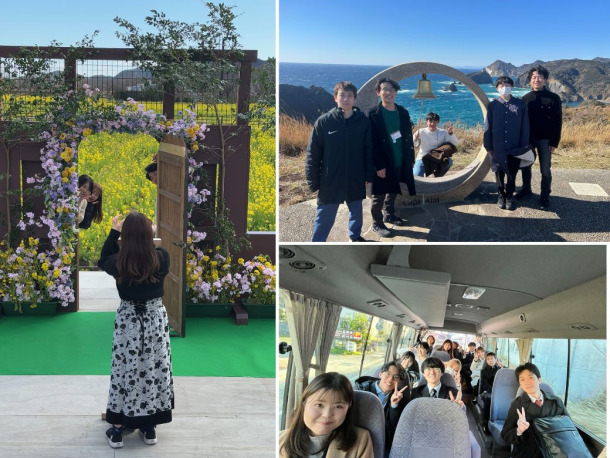
A photo taken in February in Minamiizu, where Chino participated, at a field photo spot (left). The bell of encounters at Aiai Cape, which is said to bring good fortune. Chino is second from the left (top right). A photo with members and staff with whom he shared both joys and hardships for about two months (bottom right).
What I found interesting was the diversity among the five students working in the same group. Each of us had different thoughts and goals regarding the workshop. That's precisely why we also felt the challenges. When we didn't get a good response to our interim presentation and realized that everyone's ideas were scattered, we all had an honest conversation about the fundamentals: "What do I want to do?" and "Why did I participate in the Minami-Izu workshop?" and we worked hard to refine our team's goals. It's rare to have such a deep discussion during the three months of spring break. I feel like I was able to experience a truly youthful college life.
Sugimura: The mayor of Kijimadaira said that people who help spread the word about the village's appeal to the outside world are also part of the 'related population'. Students can also do this kind of outreach. In fact, the name recognition of "Waseda University" is an asset, and I felt that this is a role that we, as Waseda students, should take on.
On the other hand, the difficult part was confusing the means with the end. Initially, with the goal of increasing the number of people with connections to the village, we were thinking of a program to gather people and let them experience Kijimadaira. But the hypothesis that we have to invite people" was fundamentally wrong. We realized this after talking with the villagers and decided to scrap the proposal.
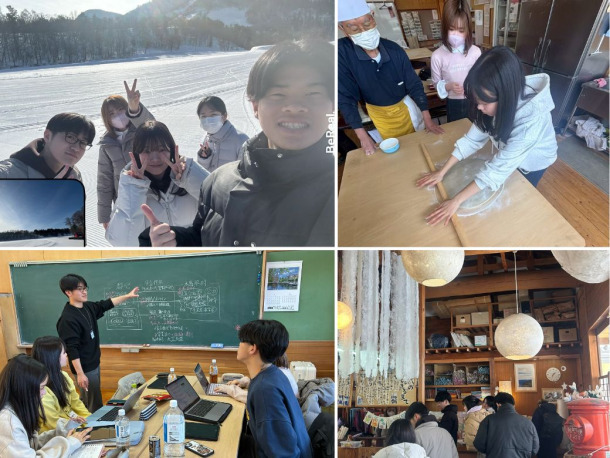
The photo shows Sugimura in Kijimadaira in February, surrounded by a snowy landscape (top left). She also shows her learning soba noodle making from a local soba noodle making research group (top right). Finally, she visited a workshop producing "Uchiyama paper," said to have originated in the Uchiyama district of Kijimadaira (bottom right). She also mentioned that she held numerous meetings there (bottom left).
Washizu: At first, I was really focused on the big theme of regional revitalization. I thought it wouldn't mean anything unless I could propose an innovative idea. But as I listened to the opinions of many people, including government officials, I realized that even small ideas that students can come up with on an individual level can be a catalyst for change in a region.
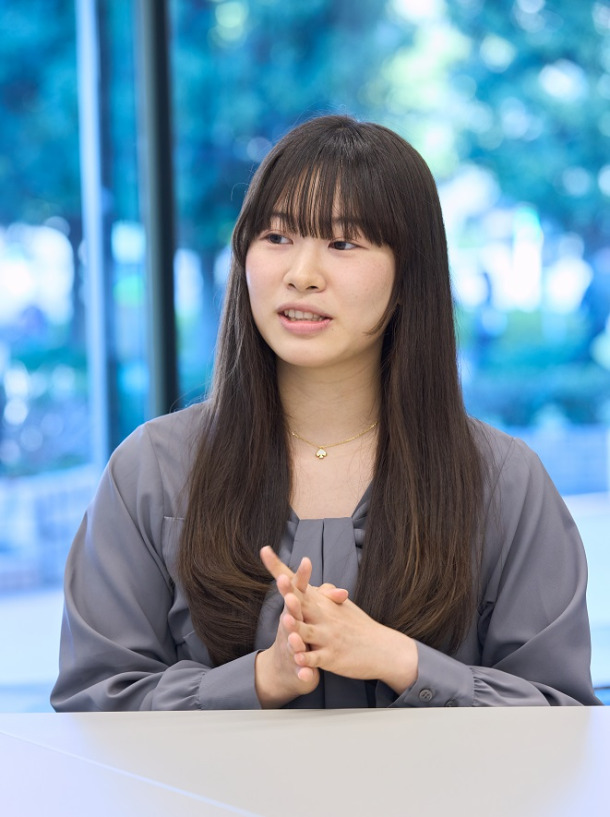
Washizu
The most difficult part was how to communicate. When we presented the challenges of Suzu's information dissemination and our proposals to address them, I remember being told by a staff member from the GCC office to be careful with your wording. We had done thorough preliminary research and taken care with our wording, but there were still times when we spoke in a definitive way. For example, we hadn't considered how someone involved in PR would feel if they heard the statement, Suzu is lacking in PR.
We want to continue to be involved with the community in our own ways in the future.
—How do you plan to engage with the regions you visited through the workshops in the future?
Washizu: After the workshop, we haven't really started any specific activities yet. However, we do want to continue in some way. Without putting too much pressure on ourselves, we'd like to start with what we can do, such as paying attention to news from Suzu or buying products from Suzu. Some of the workshop members have also come up with an interesting idea: helping out at a festival in Suzu.
Sugimura: I haven't decided what I'll do next, but I'd like to continue to have a loose connection with Kijimadaira. What I'm thinking about is the number of things I left unfinished. When there are things left unfinished, it makes me want to visit again. For me right now, the thing left unfinished is the papermaking experience. I want to gradually increase the reasons for people to visit like that.
Chino: In Minamiizu, a member who participated a year before me has started the "Rural Study Abroad Project," and I'm also involved in its activities. I'm still connected with the people of Minamiizu; they celebrate my birthday with video calls and send me "Happy Birthday" messages on social media. I feel like they're my real family. I'm so happy that the workshop has allowed individuals to connect with each other.
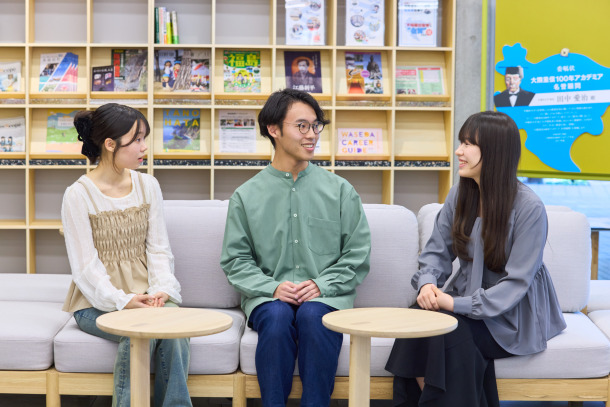
At the GCC Common Room
Interview and text: Yuuki Yamadai
Photo: Shiori Banjo
What I learned in the workshop is connected to my current job.
How do alumni participate in community collaboration workshops connecting what they learned to their future lives after graduation? We asked Tonegawa, who entered Waseda University in 2020 through the Regional Exploration and Contribution Entrance Examination (then called the New Thinking Entrance Examination), participated in a workshop in Suzu while still a student, and now works at the Cabinet Office.
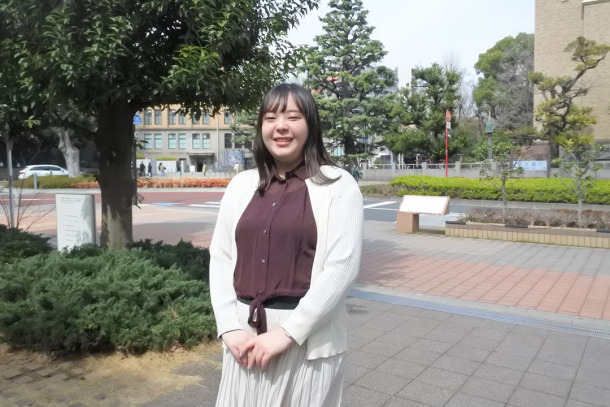
Mayuko Tonegawa, 2024 graduate of the School of Culture, Media and Society, currently working at the Cabinet Office's Local Decentralization Reform Promotion Office.
A community collaboration workshop led me to become a civil servant and engage in community-related work.
—Could you tell us what prompted you to participate in the community collaboration workshop?
I wasn't initially interested in local communities; it all started when I thought that writing an essay about Saitama, where I live, would be easy for me to write about in the New Thinking Entrance Exam. After entering the university through the New Thinking Entrance Exam, students were encouraged to take a minor course in Regional Collaboration Studies, and as part of that, there was a Regional Collaboration Workshop, which I participated in in Suzu.
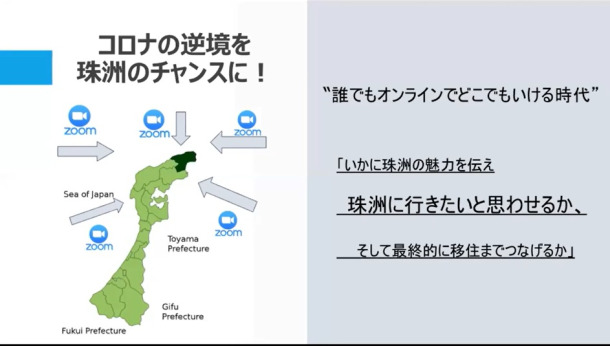
Part of the materials presented at the 2020 workshop
At the time, it was the COVID-19 pandemic, so all the workshops were conducted online. At the final presentation, we proposed an "online drive" to increase the number of people connected to the city. The plan was for people who had already moved to Suzu to take a camera and drive around the city, introducing it to prospective residents who couldn't visit in person.
—You currently work at the Cabinet Office's Local Decentralization Reform Promotion Office, so your involvement with local communities continues, right?
I originally wanted to be a civil servant, but a workshop was the catalyst for me choosing a job related to local government. I heard from an official in Suzu that "there are many other regions with similar characteristics throughout Japan. The important thing is how to raise awareness among them," and I realized that there is no end to the challenges facing local areas. I became aware of the importance of the national government addressing regional issues, and that's why I aspired to my current job.
--Please give a message to Waseda students.
The various challenges I took on during my student years have become invaluable to me today. Any experience, no matter how small, can prove useful later on in unexpected ways. I recommend cherishing each connection you make with people and the experiences you have during your student years.
Interview and text by: Yuuki Yamadai
"Waseda Roots Camp" - where student ideas come to life.
In the summer of 2025, a regional collaboration workshop was held in Saga titled "Let's make 'Saga, the Sacred Land' a place for Waseda students to visit! ~Aiming to create opportunities for Waseda-related individuals to visit Saga~". The participating student team, "Wasagashi," believed that the climate and charm of Saga, the birthplace of Waseda University's founder Shigenobu Okuma, were the roots of the current Waseda University culture, and proposed the "Waseda Roots Camp". The purpose was for current Waseda students to tour Saga and learn about its charms, thereby understanding the connection between Waseda University and Saga. This was realized in April 2026, a milestone year marking the 20th anniversary of the comprehensive agreement between the university and Saga, and 20 students, including new students, visited Saga.
Reference: Activity Report and Regional Collaboration Workshop 2025 Summer Edition (Saga)
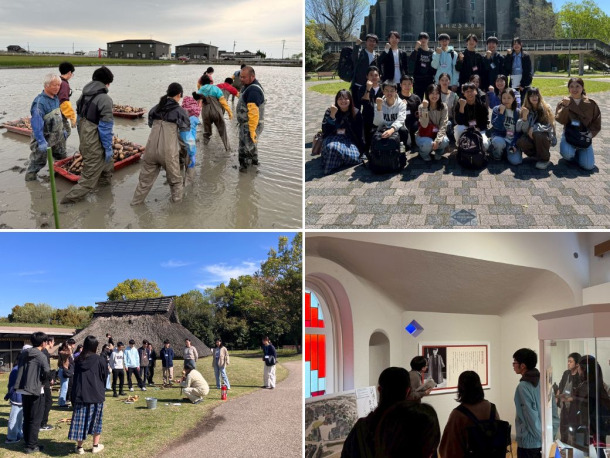
Scenes from Waseda Roots Camp. Clockwise from the top left: Experiencing planting lotus roots, a specialty of Saga; standing in front of the "Saga, the Holy Land of Waseda" commemorative plaque (the square plaque in the foreground); visiting the Okuma Shigenobu Memorial Museum; experiencing fire-starting at Yoshinogari Historical Park.
Scheduled for Summer 2026 / Regional and Corporate Collaboration Workshop
The Waseda University Office of the Global Citizenship Center (GCC Office) offers Extracurricular activity activities aimed at developing personal skills, including community collaboration workshops and corporate collaboration workshops. An online information session for the 2026 summer workshops is scheduled. We encourage you to participate. Please note that participation in the information session is a prerequisite for applying to the community collaboration workshops.
==
Recruitment period: May 29 (Fri) to June 17 (Wed), 2026
Please check the GCC office website for details.
==
Information sessions: Friday, May 29 (Wed), June 3 (Thu), June 11 (Tue), June 16 (Tue), 2026
Part 1 (Information Session): 12:30 - 12:50, Part 2 (Consultation Session): 12:50 - 13:10 (Same for all dates)
The content is the same for all dates.
Areas where the program is being implemented: Ebetsu (Hokkaido), Tanohata (Iwate) (*), Furudono (Fukushima), Suzu (Ishikawa)
* An international collaborative format is planned, with teams composed of a mix of Japanese and international students.
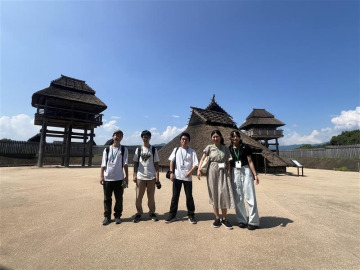
Five members of "Wasagashi," a student team from Saga who participated in a workshop and planned the Waseda Roots Camp. Photographed at Yoshinogari Historical Park during their field research.
Information session: June 1 ,(Mon), 2026
Part 1 (Information Session): 12:30 - 12:50, Part 2 (Consultation Session): 12:50 - 13:10 (Same for all dates)
Implementing company: Dentsu Inc.
"Do not think only of your own interest, your family’s interest, or the interests of your country alone, but be ambitious to contribute to humankind throughout the world." (Shigenobu Okuma)
To nurture and send out students who will contribute to the world—this has been Waseda University's unchanging mission since its founding. The three founding principles—"Independence of Scholarchip," "Practical Application of Scholarship," and "Fostering of Good Citizens"—are positioned in the current context as "Waseda Research," "Waseda Education," and "Waseda Contribution." To further deepen and develop "Waseda Contribution," Waseda University established the Global Citizenship Center (GCC) on April 1, 2024.
GCC Office's official Instagram account
GCC Office Website: https://www.waseda.jp/inst/sr/
GCC Office Official Instagram Account: waseda_pbl_program
[Next Focus Preview] "Graduate School Special" to be released on Monday, May 11th

![[Save version] Map of the four main campuses](https://www.waseda.jp/inst/weekly/assets/uploads/2026/06/110d605cfac40346aad1d2df464a6586-940x705-1-1-610x457.jpg)