We are looking for people who are not afraid of failure, are always learning, and have humility.
When job-hunting, what kind of human resources are employers looking for, and what do they look for in students? Also, what do people who have actually joined the company think about the company? This is something that many students will be concerned about. Therefore, this time, SCV (*), a student career volunteer at Career Center, asked the human resources recruiter and young employees of Amazon Japan about their questions regarding employment.
Amazon Japan is a company that operates not only retail business but also various services. SCV's Yuriko Kawamoto (second year, School of Humanities and Social Sciences) was impressed by how employees shared the behavioral guidelines, and she became more conscious of valuing connections with people, not just in job hunting. It seems that.
(*) Abbreviation for Student Career Volunteer. Student volunteers at the Waseda University Career Center who are responsible for planning, managing, and disseminating information on events and plans.
Amazon Japan
Personnel Division Student Programs New Graduate Recruiter
Minami Yamashita (Graduated from School of International Liberal Studies in 2011)
Electronics & IT Solutions Business Headquarters Audio/Musical Instruments Division Brand Specialist
Kazu Banville James (Graduated School of International Liberal Studies in 2023)
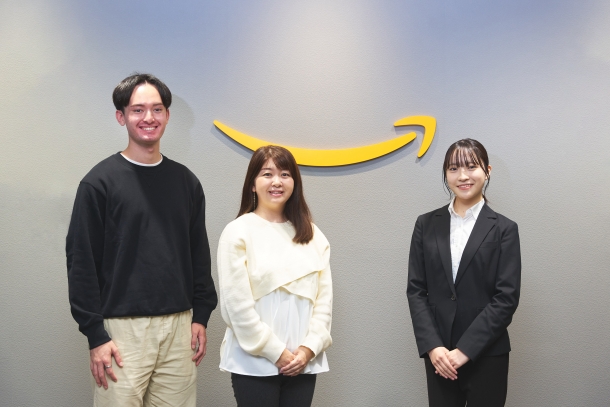
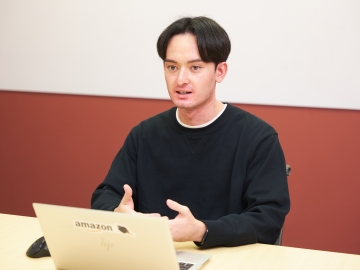
At Amazon Japan headquarters. (From left) Banville-san, Yamashita-san, and Kawamoto-san.
Full of opportunities to grow
Kawamoto: Your company has a wide range of job types. Please tell us about the characteristics and hiring methods.
Yamashita: Our company is based in Washington State, USA, and we operate a variety of online businesses centered on e-commerce. Amazon Japan (hereinafter referred to as Amazon) aims to be the most customer-centric company on the planet, the best employer on the planet, and the safest workplace on the planet. Masu. In order to meet the needs of diverse customers, we strive to provide products while enhancing our product lineup, convenience, and prices.

Amazon's corporate philosophy
Both new graduates and mid-career employees are hired by position (job type), and the content of the exam and number of interviews vary depending on the position, but all employees can expand their career opportunities around the world after joining the company. Waseda University focuses on nurturing global leaders, so I think it will be a good fit with our company.
Kawamoto: Please tell us about the human resources you are looking for and what to keep in mind during interviews.
 Yamashita: Our company has a 16-item code of conduct called "Our Leadership Principles (OLP)." To put it simply, all of our employees are leaders, and they take the initiative to identify problems and take measures to improve them in order to make our customers' lives more convenient and enjoyable.
One of the qualities we look for in leaders is ``Learn & be curious.'' Are you a person who can seek new learning, improve yourself, and explore the next possibilities? During the interview, we place emphasis on whether the applicant has the thinking and action skills that match this point.
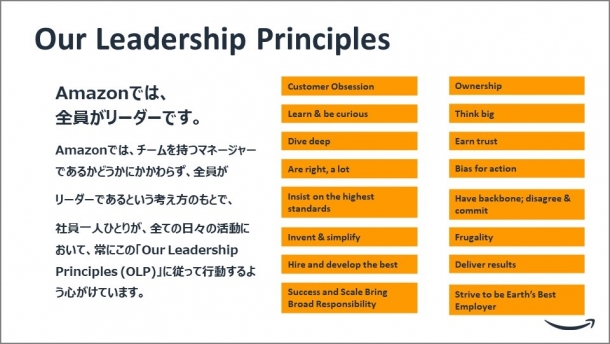
Even within the company, decisions are always made on what to do and how to do it in accordance with OLP.
What determines your ability to think and act is not what results you get, but what process you go through. I want to know the reasons why they decided to work hard and the thoughts behind their actions, so please dig deeper into the episodes in your own way, even if they are small events. It's also important to be consistent. You may be asked the same story in multiple interviews, but the interviewer may be focusing on different things. Please be careful not to add to the story or rearrange it, as it may cause concerns if the story doesn't make sense.
What leaves an impression on me is the person who is able to act proactively with a desire to improve, but at the same time has a sense of humility. At our company, we have a culture of asking our superiors for feedback. If there are areas for improvement, I believe that honestly accepting them will lead to growth, so I think the three key points are "aspirations,'' "a spirit of challenge,'' and "humility.''
Kawamoto: So you have a culture that values employee autonomy. Are there any characteristics unique to your company's corporate culture?
 Yamashita: I think the point is that you can accept the ideas of your colleagues in a positive manner. There is a culture in which people share interesting ideas with each other, and if they are good, they become reality. Because this is the basis, new businesses other than e-commerce have been born one after another.
Things other than services are being improved and implemented at an incredible speed every day, so it can certainly be said that things are moving at a dizzying pace. However, if you look at it from the other side, you can say that it is full of opportunities.
Kawamoto: Does the idea that there are many opportunities apply to changes in position, including international activities?
Yamashita: Of course. Internal recruitment systems are available both domestically and internationally. For example, if you find a position or project you want to do in the United States, anyone who meets the conditions can apply.
In my case, I am participating in a project to provide a better experience for students applying for new graduate employment. Members from Asian countries, including Japan, gather regularly to share their successes and failures, and aim to create better experiences. Recently, we have prepared an ``Application Guide'' that summarizes the selection process and frequently asked questions/FAQ. Of course, there are detailed differences depending on the country, but such information is also made open and discussed by all members.
Kawamoto: When projects with foreign countries become more popular, is it necessary to have daily conversation level English skills?
Yamashita: It would be nice to have it, and we will check your English proficiency during the recruitment exam process, but we are more concerned with whether you are not too weak in English, whether you have an attitude to learn, and OLP, rather than high English proficiency. doing. Additionally, the importance and frequency of English usage after joining the company varies depending on the position.
We also have English training and language acquisition programs within the company, so even if you are not very confident in your English skills, you can rest assured that you will have the opportunity to improve them after joining the company.
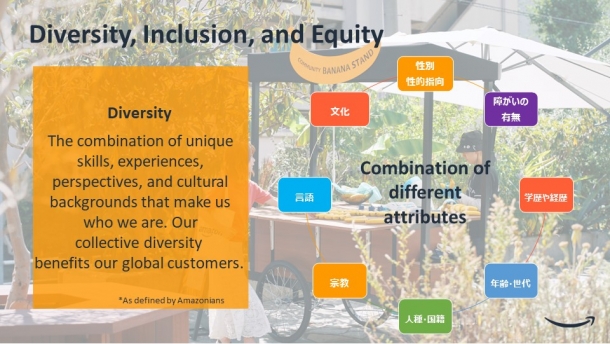
It is believed that diverse human resources are necessary for global customers.
Became a great player even after joining the company for half a year
Kawamoto: Banville, please tell us why you chose your company.
Banville: The first reason I wanted to apply was that I wanted to continue studying business administration. The second reason is that I thought it would expand my career range. As you probably know, Amazon is expanding and developing its business in a wide variety of areas around the world. I became interested in the business structure that makes this possible, and wanted to learn about it.
 Another great feature is that you can improve your skills while changing countries, business areas, and job types. I thought that if I started working on my own, I would have the opportunity to move horizontally, vertically, and diagonally, so I could build an ideal career.
I was considering the consulting industry as it would allow me to learn about management and broaden my career horizons. However, in our case, as a business company, we conduct consulting while also considering our own profit generation, so that was the deciding factor.
Kawamoto: Please tell us about your current assignment and job content.
Banville: I am in the position of a consumer general employee and a brand specialist. Specifically, my job involves consulting for domestic and overseas manufacturers.
I also participate in internal projects and am responsible for improvement work that improves the experience for customers and our employees. The targets are different, such as for regular work with manufacturers and internal projects for customers, but at the root of both of them is the commonality of "improving Amazon's customer experience."
Kawamoto: What did you focus on during your job search?
 Banville: There are several things, but the ones I particularly focused on were self-analysis and interview practice. In self-analysis, I analyzed my past experiences in detail and clarified my personality, strengths and weaknesses, and my ideal future image. At first, it wasn't organized at all, but as I organized it little by little, I was able to naturally improve my way of communicating. Proper self-analysis creates consistency in the past, present, and future. This will not only help you succeed in your job search, but it will also help you clarify what kind of life you want to lead in the future.
During the interview practice, I mainly received help from my seniors in the seminar. The seminar I belonged to put a lot of effort into supporting job hunting, so I felt like I relied on a lot of people to help me make the selection process. Actually, the reason I put so much effort into the first self-analysis was advice from a senior in my seminar. In my case, it was a seminar, but it might be a good idea to find someone to act as a job hunting mentor at student club or career seminar.
Kawamoto: Was there anything different from your expectations before or after joining the company?
Banville: I was surprised by the amount of growth opportunities. Since we are a foreign company, I thought I would have a lot of discretion, but I have been given more opportunities than I expected. I've only been with the company for less than a year, but I started working on my own around the summer and started being in charge of the manufacturer by myself. Of course, this was based on my own wishes, but I think this is an incredibly early debut that would be unimaginable for other companies.
However, in my case, I view it positively as an opportunity for growth, but some people may be overwhelmed by the amount of responsibility and difficulty. I believe that whether you want to grow faster or slower is up to you.

Kawamoto: Have you already thought about your future career plans?
Banville: Actually, nothing is clear yet. However, one option is to start a business from scratch. My father was the one who started his own business, so I think watching him run on his own from an early age influenced me. On the one hand, I admire this kind of lifestyle, but on the other hand, I also hope that as I work on various businesses at Amazon, accumulate experience, and expand my areas of expertise, the things I see and the way I think may change for the better. there is.
I don't know when that will happen, but I want to improve myself and make a choice that I won't regret.

"Failure is nothing to be afraid of," says Jeff Bezos, co-founder and chairman of Amazon.com.
Interview and text: Kimiko Abe
Photography: Nanako Ono
I value the people I meet at university and want to utilize them in my job hunting.
2nd year School of Humanities and Social Sciences Yuriko Kawamoto

What was particularly impressive was that Amazon's ``Our Leadership Principles'' have been firmly established by each and every employee and are shared as important guidelines. I found that this way of thinking is used in all sorts of situations, including work facilitation, employee evaluations, and job interviews. Because we are a large company with many job categories and a wealth of global human resources, I felt that OLP's existence has great significance in helping us align our efforts. I also think that the corporate culture of respecting employee autonomy is reflected in an environment where even new employees have a lot of discretion and can play an active role regardless of their age, which I think is attractive.
By hearing directly from the human resources staff, I was able to get many useful hints for job hunting, such as what interviewers look for in job interviews and what students should pay attention to. I also heard that he had been actively looking for a job since his second year at university, which was a great inspiration to me, as I am currently in the same year as him, and I learned a lot from him.
I heard that the interactions I had with other people at Waseda University have helped me in my job hunting and even after I entered the workforce, and this was an opportunity for me to realize once again that I should value the encounters I had with people at university. have become.
▼Click here for Japan Finance Corporation version
[Next special feature preview] “Hakone Ekiden Special” to be released on Monday, December 18th



![[Save version] Map of the four main campuses](https://www.waseda.jp/inst/weekly/assets/uploads/2026/06/110d605cfac40346aad1d2df464a6586-940x705-1-1-610x457.jpg)