Recently, we have been hearing the term "carbon neutral" more and more often. "Carbon neutral" means aiming for a balance between greenhouse gas emissions and absorption. In October 2020, the Japanese government declared that it aims to achieve carbon neutrality by 2050. Waseda University also declared the "Waseda Carbon Net Zero Challenge 2030s" in November 2021, and established the "Carbon Neutral Society Research and Education Center" the following year. We are working on various initiatives to innovate the future.
However, there are many students who do not understand how carbon neutrality relates to them. This time, we asked Yasuhiro Hayashi, director of the Carbon Neutral Society Research and Education Center, about Waseda's unique approach to carbon neutrality and specific measures. Additionally, we will introduce the voice of a student who is actually devoting themselves to research aimed at achieving carbon neutrality. At the end, we will take you on a tour to visit Waseda Arena 's "Energy Saving Points"!
INDEX
What are Waseda's unique efforts toward carbon neutrality?
▼Director Hayashi says, “Waseda students can change society because they are ‘push type’”
▼Waseda University graduate student can also feel the importance of working as one team to achieve carbon neutrality
A look behind the scenes at Waseda Arena, an energy-saving building!
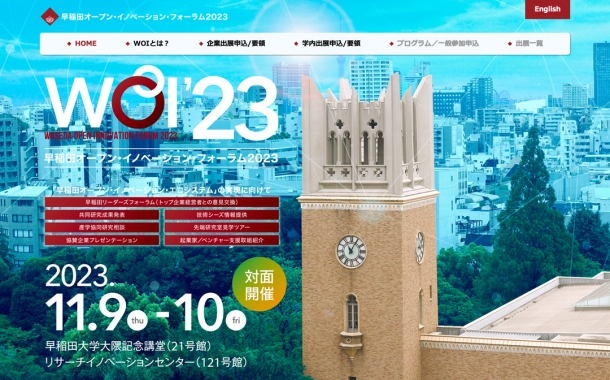
Waseda Open Innovation Forum 2023 (WOI2023)
What are Waseda's unique efforts toward carbon neutrality?
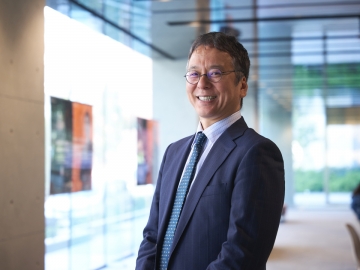
Director Hayashi says, "Waseda students can change society because they are 'push type'"
Director, Carbon Neutral Society Research and Education Center/ Professor, Faculty of Science and Engineering
Yasuhiro Hayashi
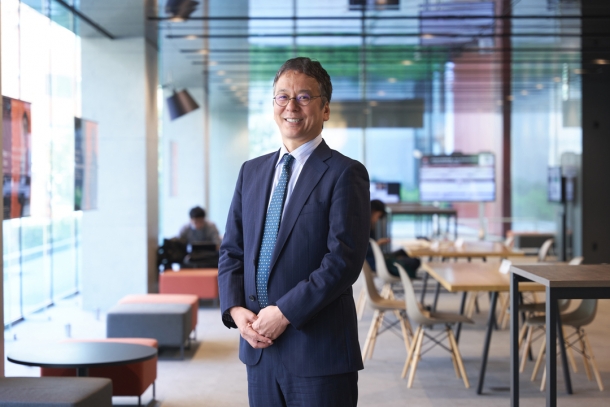
Completed a doctoral program at the Graduate School of Science and Engineering, Waseda University. Ph.D. in Engineering. He has been a School of Advanced Science and Engineering Professor at Waseda University since April 2009. Since July 2014, he has been the Director of Advanced Collaborative Research Organization for Smart Society (ACROSS) (ACROSS). Since December 2022, he has been the Director of the Center for Research and Education on a Carbon-Neutral Society. His main specialty is power engineering. Through research and development of next-generation energy management systems, we aim to build a low-carbon and sustainable society.
——What is the “Waseda Carbon Net Zero Challenge” and the role of the “Carbon Neutral Society Research and Education Center”?
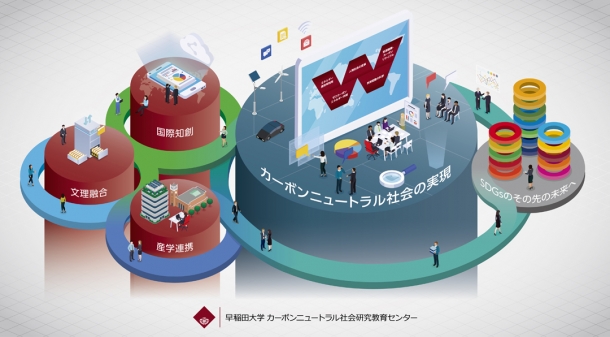
The "Waseda Carbon Net Zero Challenge" has three major missions. These are "cutting-edge research," "human resource development," and "achieving carbon neutrality on campus."
Of these, "human resource development'' requires efforts that cut across each faculty, and "cutting-edge research'' requires a trinity of industry, government and academia initiatives, such as collaboration with companies. In doing so, the Carbon Neutral Society Research and Education Center will play the role of coordinating with each faculty and serve as a hub between companies and the university.
——From the perspective of “human resource development,” what initiatives can you say are unique to Waseda University?
When we hear the phrase "carbon neutral society," we wonder if we should just work on reducing CO2 emissions to prevent global warming? It is often misunderstood. In reality, it is a very big issue that will change the social infrastructure such as the economic zone, industry, and environment.
In other words, it requires not only the technology field centered on science and engineering, but also environmental, social, economic, and sometimes psychological approaches. This cannot be achieved by "specialist idiots" who specialize in only one field.
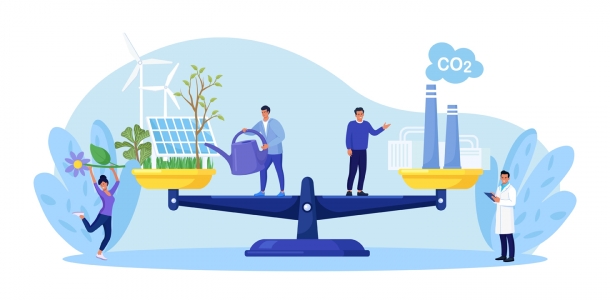
Therefore, starting in 2022, Waseda University will establish a new university-wide subspecialty, "Carbon Neutral Leader,'' with the theme of carbon neutrality. By developing educational programs that are open to all undergraduate students, regardless of whether they are in the liberal arts or the sciences, we aim to produce human resources who can promote carbon neutrality in all industries around the world, both while enrolled in school and after graduation.
Among them, one of the required subjects is "Carbon neutrality and society” (a GEC subject) is an omnibus-style course taught by seven professors who are experts in their respective fields, including economics, law, sociology, and business administration. You can deepen your learning about specific cases and the latest topics from Japan and abroad. This is a very popular class, and there were more applications than expected for the spring semester.
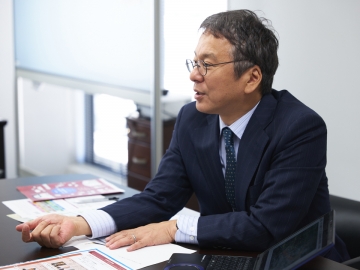
——So, what kind of “cutting-edge research” is being undertaken, especially by the trinity of industry, government and academia?
Let me introduce an example of Utsunomiya City, Tochigi Prefecture, which aims to be a "Future City of Transportation." In Utsunomiya, LRT, a next-generation streetcar that runs on electricity generated from waste, has recently become a hot topic. Furthermore, there is an intention to convert the 164 buses currently in operation to "EV buses" that run on electricity.
However, there are various issues when introducing this system, such as whether there will be a "power outage" that is running out of electricity while driving, and whether the power generation cost is worth it. My Laboratory was in charge of verifying the data.
Furthermore, based on this verification result, we applied for a Cabinet Office project (*) saying, "We should try a social demonstration!'' and it was adopted, and demonstration research will begin in October 2023 with the aim of full-scale introduction. Using a technology called digital twin, we are collecting data from real cities and conducting demonstrations in a city that is recreated on a computer.
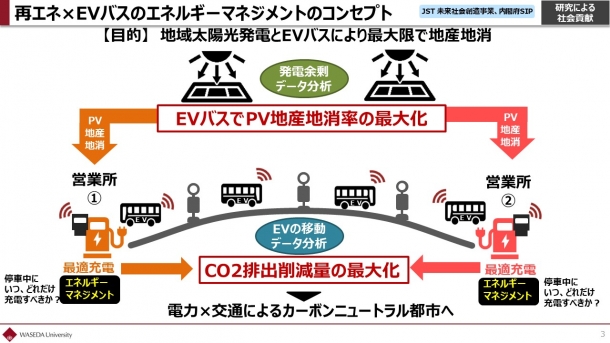
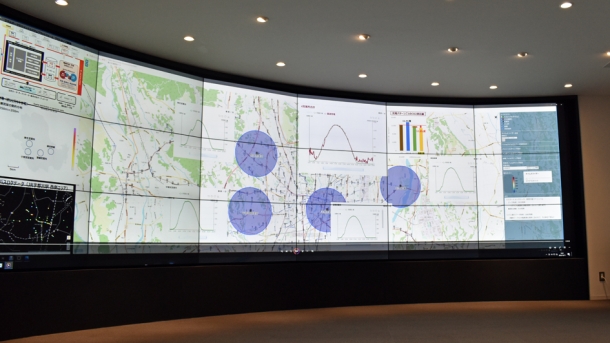
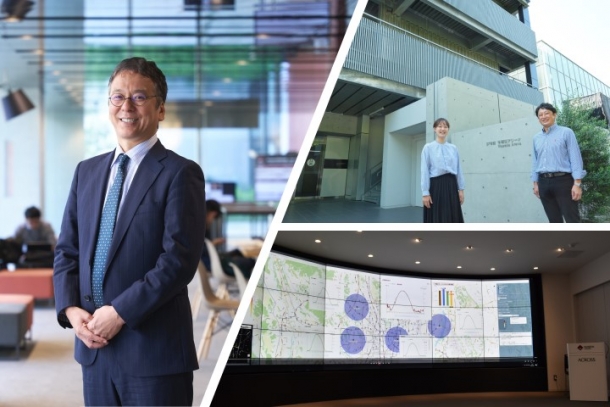
Left: Concept diagram of the EV bus project in Utsunomiya City
Right: Actual simulation results. At Waseda Campus Building No.
(*) "Construction of a smart energy management system'' is the third term theme of the Strategic Innovation Creation Program (commonly known as SIP), for which the Japan Science and Technology Agency (JST) serves as the research promotion corporation.
——Can students learn about these latest initiatives at “Carbon Neutral Leader”?
Yes, they can! In fact, in my lecture, I spend one frame passionately talking about this Utsunomiya case (lol). In addition to me, this class is taught by a number of teachers who serve as chairs and deliberation committee members of various strategic councils promoted by the Cabinet Office. Therefore, it is possible to keep up with the latest trends in the country.
To begin with, Waseda University is currently attracting attention from around the world not only for its education but also for its research. We are active in "industry-academia joint research,'' which involves working on research together with companies, and the percentage of faculties who publish their results in papers is one of the highest in the world, ranking 4th in the world.
What's amazing about Waseda University is that they have created a system where students can learn by carefully breaking down the points of cutting-edge research that is actually being carried out in Japan and abroad and incorporating them into lectures. Indeed, we operate with "research" and "education" as two wheels.
Therefore, if you are a student who wants to deepen your learning about carbon neutrality, please take the "Carbon Neutral Leader" course starting next year and actively ask questions. In addition to lectures, we will also be holding “Waseda Open Innovation Forum 2023 "Such, There are many opportunities to touch on the topic of carbon neutrality. Please come and join us.
--It seems like students themselves can see a lot of things by being active.
It's wonderful that Waseda University students are often the "push type" who are acting on their own initiative. Additionally, many students have the ability to involve their peers in researching things they do not understand.
"Carbon neutral society" is, after all, about our future selves. You all use electricity and gas every day, and you also travel by vehicle, so it is closely related to your daily life. That's why I want you to move towards making this a reality, with a strong mindset that it's for the sake of the world and for people, without thinking of it as just another person. If you can think about it as your own thing, you can make use of the vitality and involvement that only Waseda University students have to accomplish something.
Furthermore, my generation will not always be able to conduct cutting-edge research toward Japan's goal of 2050. It is your generation that will further develop and realize current research issues. I hope that everyone will join together in our task, just like in a relay race.
At Building 121
Interview and text: Naoto Oguma (Graduated from School of Letters, Arts and Sciences II in 2002)
Photography: Nanako Ono
▲Return to top
Waseda University graduate student can also feel the importance of working as one team to achieve carbon neutrality
Natsuno Kato, 2nd year master's program, Graduate Graduate School of Advanced Science and Engineering
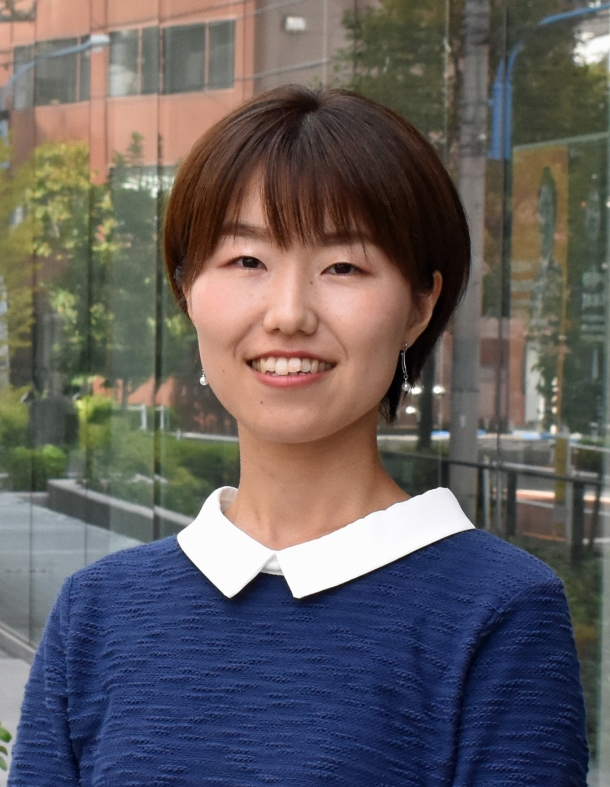
I chose Hayashi Laboratory because it allows me to directly approach environmental issues. When I was in my first year of university, I went to New Zealand to study abroad, and I was surprised by the high degree of environmental awareness that was integrated into daily life, and my interest grew. I thought that this laboratory could contribute to achieving carbon neutrality and solving environmental problems from an energy perspective.
My research topic is sector coupling between electricity and transportation. Sector coupling is a concept that solves problems and creates new value by accommodating energy between different infrastructure sectors. Specifically, we are conducting research on how to effectively utilize renewable energy in local areas using EV buses. While EV buses can run without emitting CO2 by using electricity derived from renewable energy, they can place a burden on the power grid if they are not properly charged and discharged. Therefore, I am trying to come up with an optimal charging schedule in terms of power consumption while also maintaining the operational status of the buses.
Around the world, many people are working towards achieving carbon neutrality in a variety of fields. I feel like we are part of a team with people who share the same goal, and it gives me the energy to find meaning and hope in my own research. Regardless of whether you are in the liberal arts or the sciences, it is important that we all move towards carbon neutrality "together'' in our own ways.
A look behind the scenes at Waseda Arena, an energy-saving building!
Waseda Arena on Toyama Campus is used for events such as Entrance Ceremony and Convocation. In fact, did you know that the building is not only new but also highly energy-efficient, having won the SDGs Architecture Award in January 2023? This time, Satoshi Tanaka, an employee of Planning and Construction Section, taught us many energy-saving points at Waseda Arena!
Planning and Construction Section Satoshi Tanaka
Waseda Weekly Reporter Shino Watanabe 2nd year School of Education
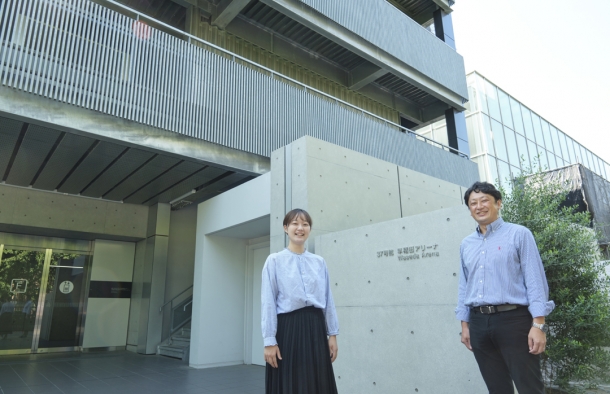
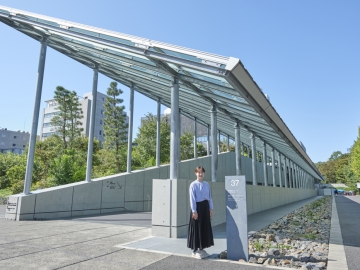
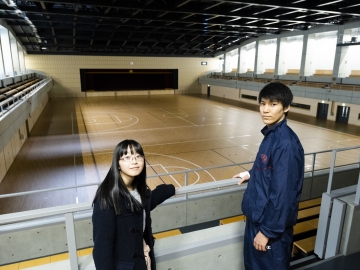
Shino and Satoshi in front of Waseda Arena high-rise building (Building No. 37)
Satoshi: The first point is the solar panels on the roof of the high-rise building. Although it cannot be seen from the ground, this monitor allows you to see at a glance how much power is being generated.
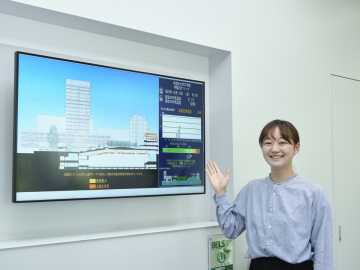
The monitor is next to Starbucks coffee.
Satoshi:"Toyama Hill'' is a 1-meter mound of earth on the roof of Waseda Arena. Many plants were planted to form a "green network'' that connects the Kanda River to Waseda Campus and to Toyama Park, which was a garden during the Edo period.
In addition, rainwater received from the glass roof above the grand staircase is collected in an underground water tank through gravel spread on the ground and used for daily watering. The second point is that almost no energy is used to maintain the greenery.
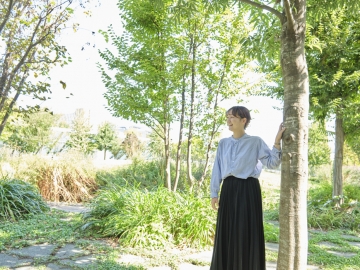
Left: Toyama Hill is said to be an environment where native plants can easily grow.
Right: The amount of rainwater stored is approximately 220 tons!
Satoshi: Let's go into Waseda Arena. Because it is underground, the temperature here is stable at about 18 degrees. Furthermore, the building is made of concrete, which stores heat easily, and thanks to Toyama Hill directly above, there is no direct sunlight, making it easy to maintain the indoor temperature in any season, eliminating the need for air conditioning.
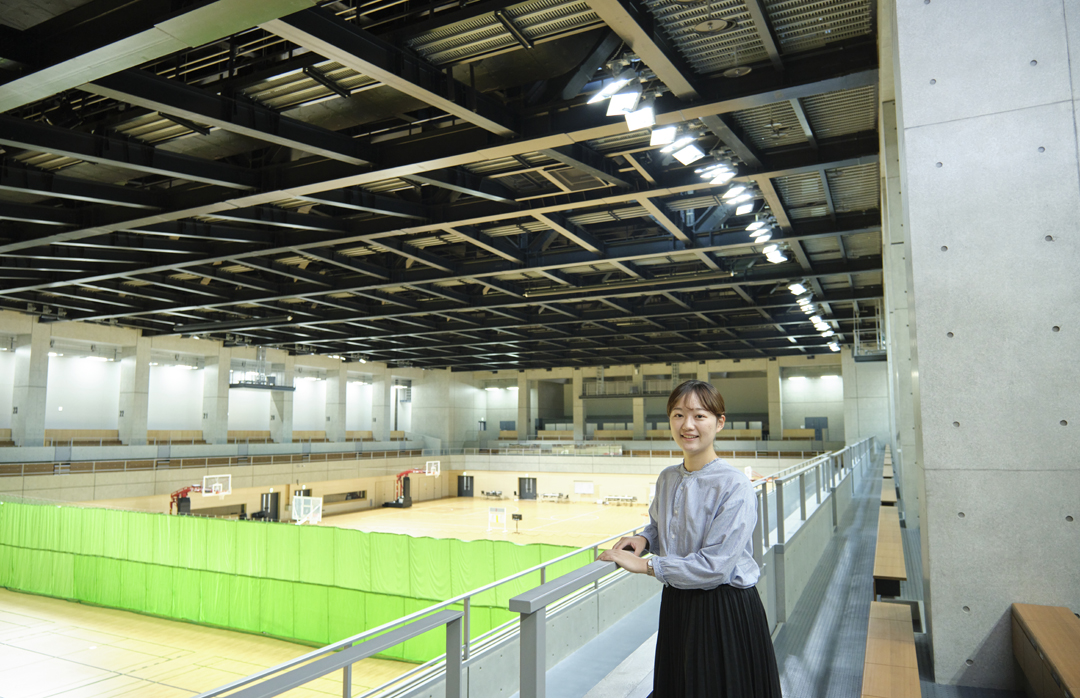
The arena has an automatic ventilation system and uses LED lighting to create a comfortable and energy-saving environment.
Satoshi: However, it can be difficult to maintain room temperature when there are many people, such as Convocation and Entrance Ceremony. In such cases, we use an air conditioning system that utilizes a heat storage water tank beneath the arena. This tank uses underground heat to store water at a stable temperature of about 18 degrees Celsius. By using water at a constant temperature for air conditioning regardless of the season, there is no need to use excessive energy to run the air conditioner, which is an eco-friendly point.
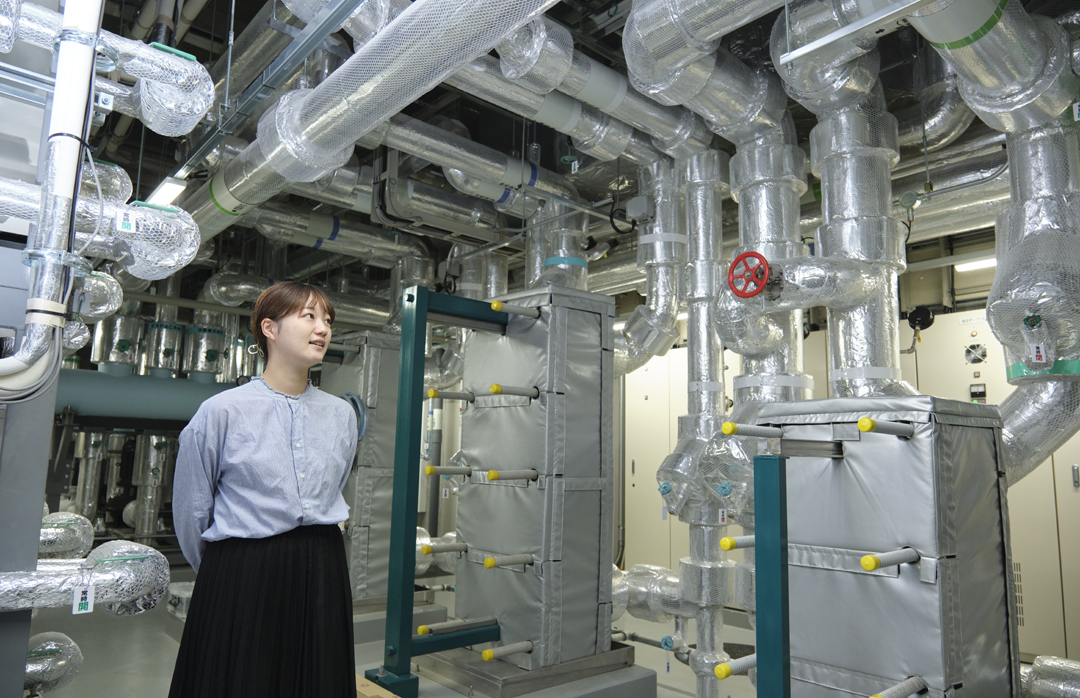
Shino went to the equipment room that you can't usually enter! The heart of creating an energy-saving Waseda Arena
Watanabe
I had a strong impression that Toyama Campus was a stylish place, but I never knew it was such an eco-friendly place! What's more, Waseda Arena has received ZEB Ready certification, which indicates that it consumes more than 50% less energy than a standard building of the same size. If you listen to the many energy-saving points this time, you'll understand.
Photography: Seiji Ishigaki
▲Return to top
Waseda Open Innovation Forum 2023 (WOI2023)
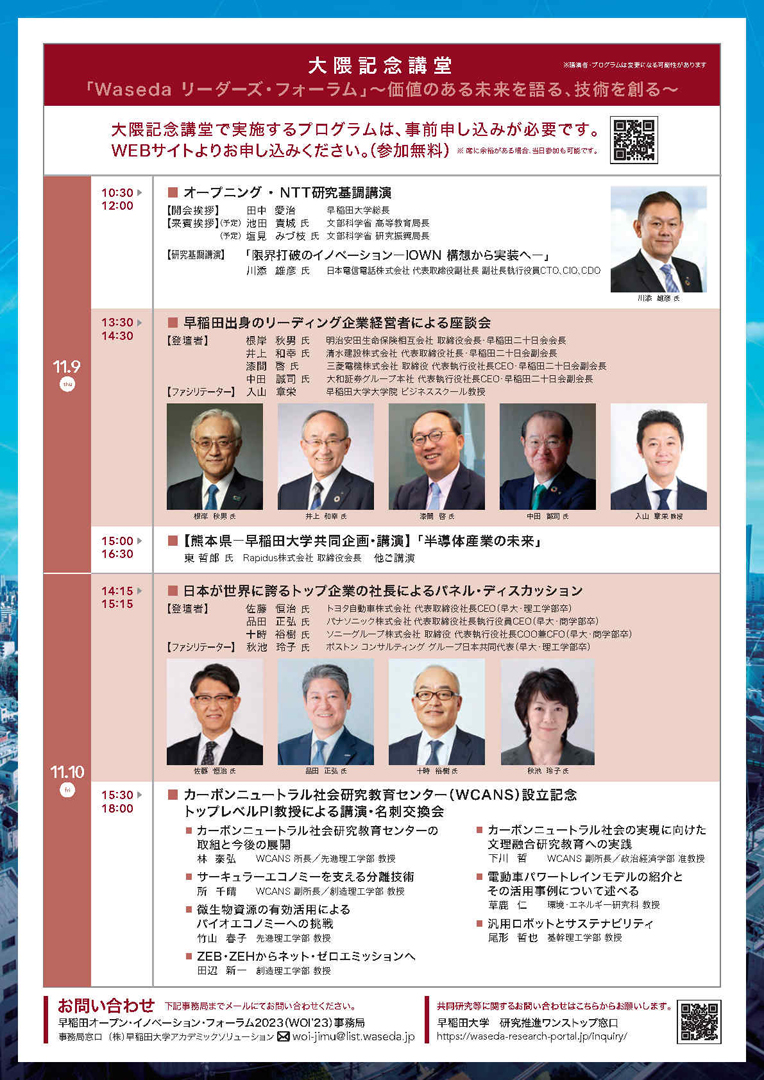
(Click to enlarge)
WOI is an industry-academia-government collaboration event that introduces cutting-edge research being conducted at the university, university-launched ventures, and gives lectures by business people, with the aim of realizing "Waseda for Research."
"This year, many top company presidents are scheduled to appear on stage, including President Tsuneharu Sato (Toyota Motor Corporation) and President Masahiro Shinada (Panasonic Corporation)! This will be the last time that such a prestigious group of people will be together. I would love for many Waseda University students to come." (Director Hayashi)
Date: Thursday, November 9th, Friday, November 10th, 2023
Venue: Okuma Memorial Auditorium, Building 121 (In-person event)
Website: https://waseda-oif23.jp/
*Advance application is required to participate in some programs. Apply here
[Next Focus Preview] “Reading Special” to be released on Monday, November 13th

![[Save version] Map of the four main campuses](https://www.waseda.jp/inst/weekly/assets/uploads/2026/06/110d605cfac40346aad1d2df464a6586-940x705-1-1-610x457.jpg)