Euclid Space Telescope Discovers Record-Breaking Ancient Supermassive Black Holes Ever Observed at Cosmic Dawn
An international research team including Assistant Professor Masafusa Onoue of the Waseda Institute for Advanced Study has discovered 31 distant quasars using observations from the European Space Agency’s (ESA) Euclid Space Telescope. Quasars are extremely luminous objects powered by the accretion activity of supermassive black holes at the centers of galaxies. Two of the new quasars are observed just 670 million years after the birth of the Universe, setting a new observational record for the most distant, and therefore most ancient, black holes ever discovered. This discovery provides evidence that mature black holes already existed in the early universe, when the Universe was only 5% of its current age. Data from the Japanese Subaru Telescope also contributed to this remarkable discovery.
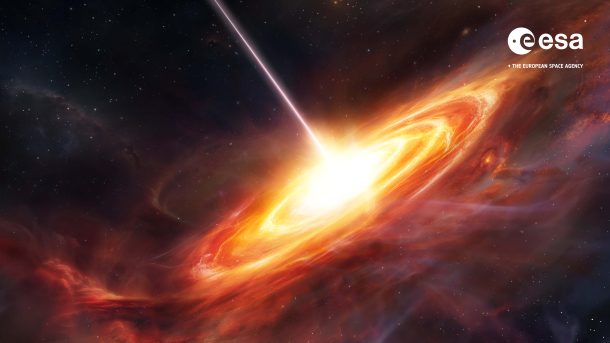
Artist’s Impression of Quasar(provided by ESA)
Researcher’s Comment
One of the major mysteries in modern astronomy is when and how supermassive black holes residing at the centers of galaxies formed over the long history of the Universe. Japanese researchers have long contributed to this effort through searches for distant quasars with the Subaru Telescope. This new discovery, enabled by Euclid’s outstanding infrared observations together with Subaru’s optical imaging of the same field, has pushed the distance record even further, making the mystery of supermassive black hole formation even more striking. As Euclid’s observations have only just begun, I look forward with great anticipation to the discovery of even more distant supermassive black holes in the years ahead. (Masafusa Onoue)
Related Links
-The Subaru Telescope press release (URL) is posted here.
-The Ehime University press release (URL) here is posted here.
-The Euclid press release (URL) is posted here