The World of Business Analytics Expands Limitlessly Through Industry–Academia Collaboration
“Is this jacket too casual?” “Yes, how about this one?”
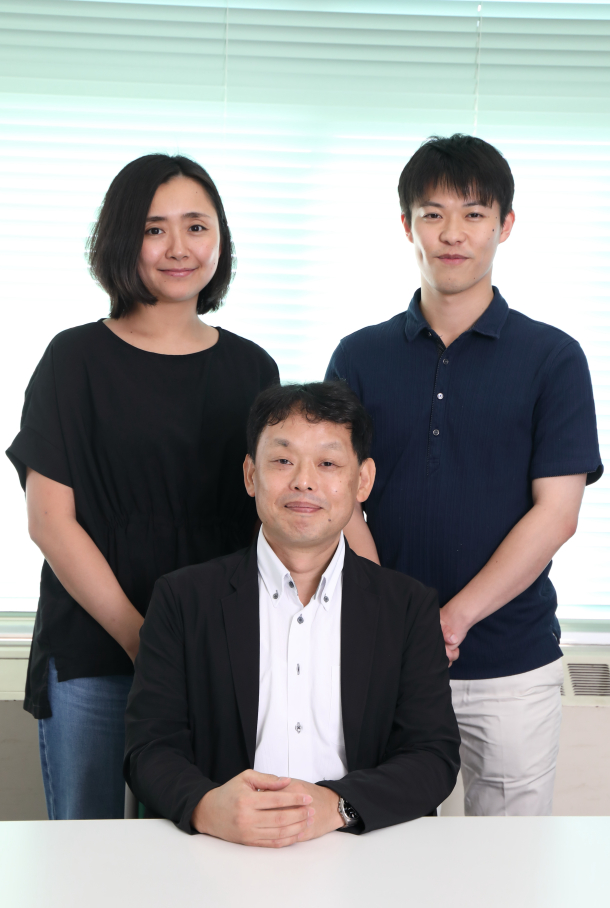
Technology is evolving every day to the point where such a conversation with an AI store assistant could become possible. Behind this kind of development is the academic field known as data science. It spans a wide variety of disciplines related to data analysis, and by leveraging collaboration with industry, it opens up new possibilities in business analytics. We asked Director Prof. Masayuki Goto, Research Associate Ayako Yamagiwa, and Research Associate Yuta Sakai about this exciting work.
◆Mobilizing knowledge from all fields for data analysis
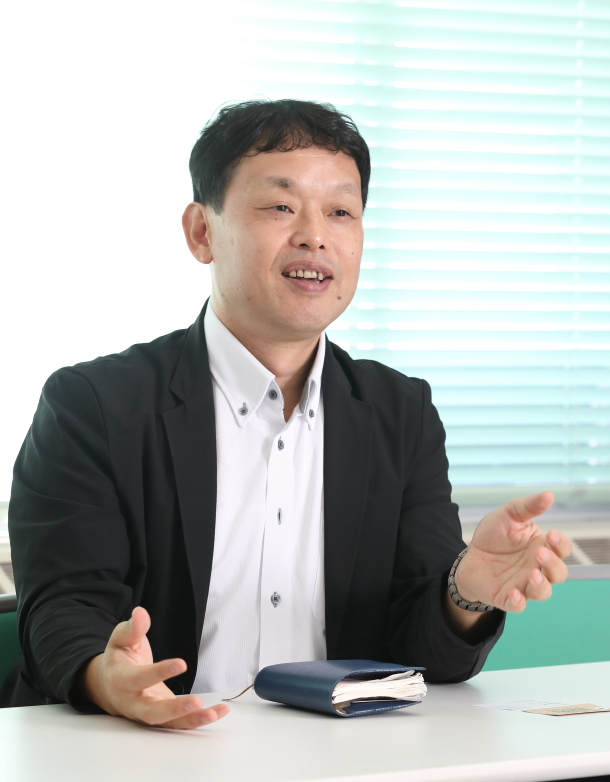
Director Prof. GOTO, Masayuki
──The term “data science” has already become familiar in society, but academically speaking, what kind of research does it involve?
Goto:
In the world today, vast amounts of diverse data with different structures and content are accumulated every day through things like business activities and consumers’ daily lives. For example, the purchase history data collected from a local shop’s POS system or from e-commerce sites is just one type of that data. The academic discipline of data science focuses on scientific methods to analyze those huge amounts of data and derive useful insights.
Traditionally, data was analyzed in various fields like mathematics, statistics, information engineering, pattern recognition, machine learning, artificial intelligence, marketing, and industrial engineering. However, in many cases the analysis started with a specific purpose in mind — you collect data to answer a question you already have. For example, in medical trials to evaluate drug efficacy, you divide participants into groups with and without treatment.
But in data science, the data already exists first, and researchers integrate methods from diverse disciplines to extract new knowledge from that data. In that sense, data itself takes center stage. Why? Because we are now in an era in which big data is accumulated in every corner of society, often as logs that were originally recorded for purposes other than analysis, yet as this data grows, the potential to create entirely new value also grows. This need to analyze data from within — rather than only collecting data to answer a pre-defined question — is why it is crucial to combine methods from many academic domains. Systematically organizing these approaches into an academic discipline is the role of data science.
──So that’s why researchers at the Institute of Data Science come from such wide-ranging backgrounds?
Goto:
Yes — it’s truly interdisciplinary. At our university, we have faculty with specialized expertise participating from places like the Faculty of Science and Engineering, the Faculty of Commerce, the Faculty of Human Sciences, the Faculty of Social Sciences, the Center for Data Science, and more. We also welcome invited researchers from other universities such as Yokohama City University, Tokai University, Josai International University, Tokyo City University, Sophia University, Keio University, Toyo University, and more. Moreover, many people from different industries join us as research partners. The actual data held by companies is essential for this research, and we also study how methods from business analytics can be implemented in real corporate management and business practices.
◆New business possibilities opened up by data science
Today, we were joined by Ayako Yamagiwa and Yuta Sakai, doctoral students studying in the Goto Laboratory and also participating in the institute’s activities as research associates.
──What research activities are the research associates involved in?
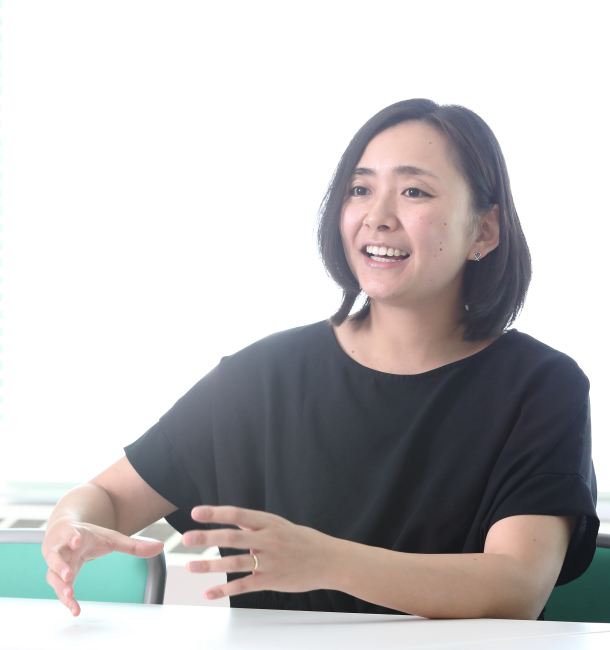
Ayako Yamagiwa
Yamagiwa:
I study ways to quantify the subjective impressions people have when they see or hear something — using machine learning and AI. For example, when someone sees a flower or an animal, they might think “That’s so beautiful” or “That’s cute.” Those impressions are ambiguous and differ by person. But from a business perspective, that is valuable information. If we can identify the subjective impressions common to certain groups of people, we might be able to build more effective marketing and sales strategies.
Goto:
Thanks to highly developed artificial intelligence, image recognition technology has improved dramatically. For example, it’s safe to say that facial recognition using images is nearly 100% accurate. However, as Yamagiwa mentioned, it’s still difficult for AI to distinguish between images that are perceived differently by different people. Suppose there is a product that 20 out of 100 people would say is cute, and the remaining 80 would say it’s not cute or neither. What if AI could identify the market for those 20 people and reliably sell it to them? One e-commerce company that sells fresh flowers has shown great interest in this basic research.
Sakai:
I research the reliability of machine learning models. For example, when distinguishing between cats and tigers, how does the machine learning model classify them? As humans, we can tell from our experiential impressions of facial shapes, but the model does not necessarily make the same judgment as humans. Conversely, when a machine makes a mistake in distinguishing between a cat and a tiger, which part of the judgment caused the error? If we can get to the bottom of this, we can use the model while recognizing the possibility of mistakes. In other words, it will enable safer and more secure operation.
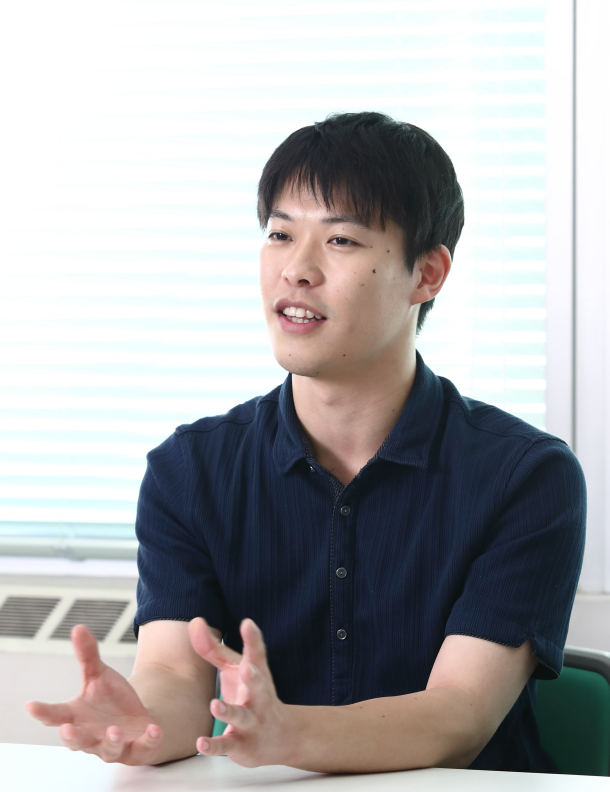
Yuta Sakai
Goto:
This is fundamental research into a technology known as explainable AI. When an AI answers, “That’s a cat,” there is a huge amount of training data behind it, but we don’t actually know why it made that decision. This is a major problem in business. For example, if an AI embedded in a convenience store’s surveillance camera catches a customer behaving suspiciously and warns them of shoplifting, it’s difficult to blame them without knowing the exact reason. Or, if an AI determines that a promotional coupon is valid for a certain demographic, and it turns out to be incorrect, losses will be incurred. Decisions cannot be made without an explanation of why it’s valid. The need for such explainable AI will only continue to grow in the future.
◆Industry collaboration and real-world implementation
──So, data science can greatly expand business possibilities. Can you talk about themes in joint research with companies?
Goto:
There are too many to list, but for example, Yamagiwa is working with a finance company analyzing customer complaints data. These records are diverse and not originally meant for analysis, but they might hold insights into reducing complaints. Another project involves analyzing logs from a Q&A site used by new mothers — again, a large volume of data with unknown potential. Is it a new business, an improved website design, or improved response accuracy? The fact that we don’t know is what makes it fun.
──Some of the results of joint research have been announced to the press.
Goto:
As a recent example, in collaboration with ZOZO Research, we developed technology that uses AI to automatically interpret ambiguous expressions about fashion. People often say things like, “Please dress casually,” but many people don’t really know what constitutes casual and what constitutes formal. This is the “Fashion Intelligence System,” which allows AI to learn these uncertain images and answer questions from users. If you say, “I’d like the upper half of this outfit to be a little more formal,” the AI will suggest, “How about this?” It’s very convenient, isn’t it? Ryotaro Shimizu, an alumnus of Waseda University and a member of the ZOZO Research, is participating in this joint research.
──What do you two find interesting about joint research with companies?
Yamagiwa:
It’s rare that we have decided from the beginning on which theme we want to conduct research, and it’s fun to see our ideas expand as we talk, thinking things like, “It would be interesting if we could realize this,” or “This could lead to business opportunities.”
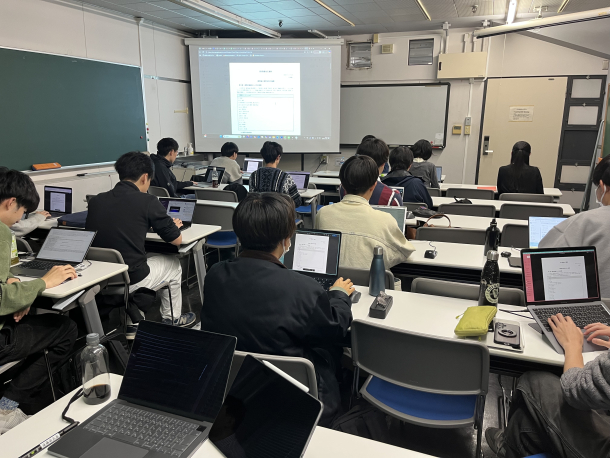
Students from Goto’s seminar also participated in joint research with companies, experiencing the potential of business analytics.
Sakai:
In research with a company that investigates real estate information, we are currently working on a project to predict which properties are likely to be sold in the future based on the characteristics of properties that have been sold in the past. As with the research with ZOZO, it is an extremely interesting topic to consider what kind of impact can be achieved by implementing measures and what kind of approach to which demographic. It would be interesting to conduct research that can be useful for such groupings.
◆How generative AI will shape the future of data science
──Generative AI is developing rapidly. How does this impact data science?
Goto:
Its impact is huge. This field of study is about how to cook delicious dishes using the raw material of data. To do this, we need to constantly sharpen our analytical tools, which are like cooking utensils like pots and knives. That is the role of basic research, but it’s like adding an ultra-powerful tool called generative AI to it. To put it in perspective, it’s like when you have the idea of ”I want to slice 100 onions perfectly!” and a perfect tool appears that instantly makes that idea a reality. How can we use this to create value? Currently, research into how to use it, or what you might call recipes, is a hot topic in academic circles.
──The Institute of Data Science completed its second 10-year term in September 2025 and entered its third term. Will the use of generative AI be included in your future goals?
Goto:
How can the use of generative AI be systematized in the field of data science? I would like to contribute to this while accumulating know-how at this research institute. Generative AI can be a capable and nimble colleague, but the quality of its work currently varies greatly depending on how it is used. How can we use generative AI to efficiently produce analytical results at the same level as data science specialists? I would like to spend the next five years exploring this issue.
Sakai:
I hope to help build environments where people who aren’t familiar with AI can still use it effectively, and where diverse data useful for society can be collected.
Yamagiwa:
To that end, I look forward to collaborating with businesses and other practitioners. I hope that the use of data in the business world will progress, ideas that we in academia would never have thought of will emerge, and the synergistic effects of both parties will be seen in more situations.
Goto:
I look forward to seeing what the younger generation will do.