Event Outline
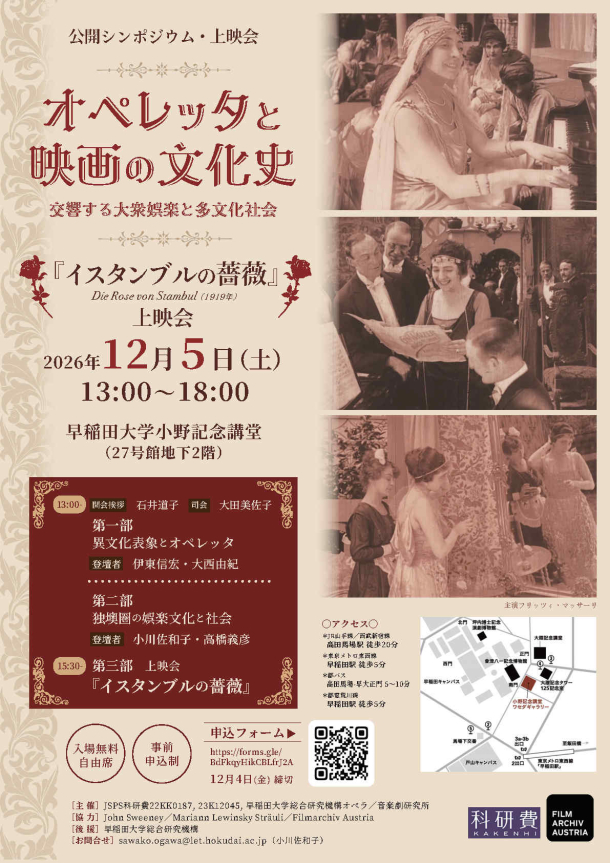
- Date and Time: Sat. 5 December 2026, 13:00–18:00 (JST)
- Venue: Ono Auditorium, Waseda University
- Admission: Open to the public; advance registration required
- Language: Lecture in Japanese
- Organized by: Waseda Institute of Research in Opera and Music Theatre (WIROM), Comprehensive Research Organization, Waseda University
- Supported by: Comprehensive Research Organization of Waseda University
- In cooperation with: John Sweeney/Mariann Lewinsky Sträuli/Filmarchiv Austria
This project is supported by JSPS KAKENHI Grant Number 22KK0187, 23K12045
Overview
“… mein altes Vaterland, die österreichisch-ungarische Monarchie […] ist fast unwillkürlich aus der Operettenaufführung in das schreckliche Theater des Weltkriegs gegangen.“ [my old homeland, the Austro-Hungarian Monarchy, […] passed almost involuntarily from the operetta performance into the dreadful theater of the World War.]
These are the words left by writer Joseph Roth in 1932, before ultimately passing away in exile in Paris. This symposium will examine various aspects of operetta and cinema in Central and Eastern Europe, Germany, and Japan from the late 19th century through the post-WWII era. Themes to be explored will include the representation of multiethnicity during the Donau Monarchy, exoticism that served as an escapist refuge for citizens exhausted by World War I, and documentary narratives of postwar Vienna following the 1938 annexation of Austria by Nazi Germany and World War II.
Analyses from the perspectives of film history, musicology, the history of political thought, and comparative literature, and using Roth’s words as a guiding thread, will shed light on an issue of enduring contemporary relevance: how the realities of war and society imperceptibly blurred into a seamless continuum with fiction.
Program
13:00-
[Opening Remarks] Michiko Ishii (Director, Institute for Research in Opera and Music Theatre, Comprehensive Research Organization, Waseda University)
Moderator: Misako Ohta
[Part 1] Multicultural Representation in Operetta
Nobuhiro Ito, The Genealogy of the Vienna–Budapest Operetta: “Die Zigeunerbaron”, “Die Csardasfürstin”, and “Zigeunerliebe”
Yuki Onishi, Where Can We Find Das Land des Lächelns? Representations of “the Orient” in Wartime Japanese Operetta
[Part 2] Popular Entertainment and Society in the German-Austrian Sphere
Sawako Ogawa, Die Rose von Stambul Blooms: Stage and Screen in Germany and Austria during the First World War
Yoshihiko Takahashi, The True Story of “The Third Man”: Light and Shadow in Postwar Vienna
15:30-
[Part 3] Film Screening: The Rose of Stambul (Die Rose von Stambul)
(1919, German film, starring Fritzi Massary, directed by Arthur Wellin, 73 min.)
[Pre-screening Lecture] Sawako Ogawa, From a Viennese Girl to a Berlin Operetta Diva: Fritzi Massary’s Starring Role
With Japanese subtitles. Accompanied by a pre-recorded performance provided by Mr. John Sweeney.
General Discussion and Q&A
[Closing Remarks]
Registration
Admission is free, but limited to the first 150 registrants. Advance online registration is required.
Registration Form ▶︎ https://forms.gle/BdFkqyHikCBLfrJ2A
Registration Opens: Sunday, October 11, 2026, 12:00
Registration Closes: Friday, December 4, 2026, 23:59
・If we reach the maximum number of participants before the deadline, the registration will be closed at that time.
・Please submit one application per person.
・If you plan to attend in a wheelchair or have any concerns regarding venue accessibility, please contact us in advance using the inquiry details provided on the flyer so we can guide you on entry/exit procedures and ensure your safety.
Contact
sawako.ogawa[at]let.hokudai.ac.jp ([at] = @)
Profile
OHTA Misako is a professor at the Graduate School of Human Development and Environment, Kobe University, and an adjunct researcher of Waseda Institute of Research in Opera and Music Theatre (WIROM). Her research focuses on the cultural history of music.
ITO Nobuhiro is a specially appointed professor at Nakanoshima Arts Centre of the University of Osaka. His research initially focused on the works of Bartók but subsequently expanded to include the study of Eastern European folk music and later Eastern European popular music.
ONISHI Yuki is a lecturer of comparative literature and culture at Daito Bunka University in Saitama, Japan and an adjunct researcher of Waseda Institute of Research in Opera and Music Theatre (WIROM). Her research explores Western-influenced music theatre in Japan, which emerged around 1910.
OGAWA Sawako is an associate professor at the Faculty of Humanities and Human Sciences, Hokkaido University, and an adjunct researcher of Waseda Institute of Research in Opera and Music Theatre (WIROM). Her research focuses on comparative film history.
TAKAHASHI Yoshihiko is a professor in the Faculty of Law at Hokkai Gakuen University. His research focuses on the political and cultural history of 20th-century Austria.