
Takumu TEZUKA
- Posted
- Tue, 10 Feb 2026
Takumu TEZUKA | 1st year master student, School of Fundamental Science and Engineering
- Visiting period: Sept.,2025 to Nov.,2025
- Visiting university: Université Libre de Bruxelles (ULB)
- Visiting country and region: Belgium Kingdom, Brussels
I applied for the overseas program in order to acquire technical skills related to experimental equipment. I aimed to learn how to operate and manage experimental setups and to further develop my own research on fog nets by studying under Professor Denis Terwagne, who has an established track record in fog net research. In addition, I was attracted by the travel support provided by the SGU program, which also motivated me to apply for overseas dispatch.
During the three-month stay, I learned how to use the experimental setup in the first month. In the remaining two months, I fabricated new fog nets and evaluated their performance, focusing on kirigami structures different from conventional designs. The collected data are currently being analyzed for publication.
The Université libre de Bruxelles is located in central Brussels and offers a quiet research environment. The laboratory mainly consisted of PhD students, and discussions were conducted in small groups. They spoke French language in the lab, but they spoke English when necessary. I was able to work in a multicultural environment with members from several countries, where cultural differences were naturally respected.
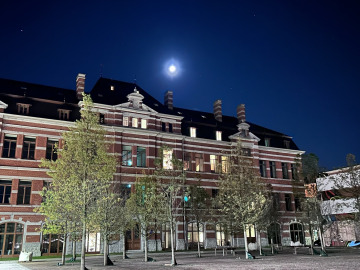
Brick-built campus.
International Exchange
Students from several countries gathered in the laboratory. We often ate sandwiches together for lunch and sometimes went out for a beer after research. French was mainly used in the lab, but many students and staff could also speak English and switched between languages depending on the situation. Seeing them communicate smoothly in multiple languages was very inspiring to me.
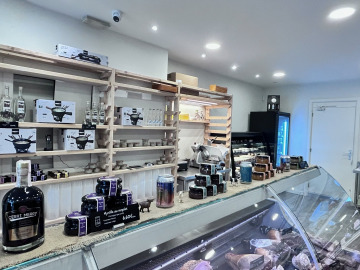
A sandwich shop near the campus.
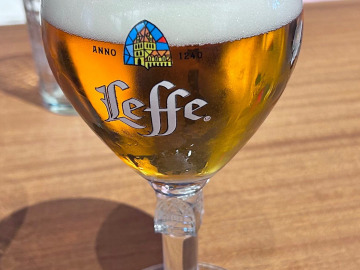
Having a beer with lab members after research.
Residential Environment
I stayed in a house located about 30 minutes from the laboratory by train and tram. I used Airbnb and lived with the host and her two children, in a setting similar to a homestay. The biggest challenge during my stay was communication. The host family mainly spoke Spanish, which I do not speak at all. So, it was difficult to communicate with each other. However, I found many similarities between Spanish and English, as well as unique pronunciation patterns. As a result, the three months were stimulating and never boring.
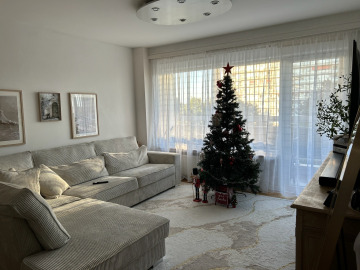
The living room of my accommodation.
Surrounding Environment
The area around my accommodation was well equipped with a metro station, large supermarkets, and a shopping mall within walking distance, so I had no difficulty in daily life. The area was a residential area with many schools, and public safety was good. I never felt unsafe even when walking alone at night.
In addition, on the third Sunday of September, private car use is generally prohibited throughout Belgium. On that day, public transportation in Brussels is free of charge. While the streets became unusually quiet, festivals were held at the World Heritage site Grand-Place, and the city was filled with a lively atmosphere.
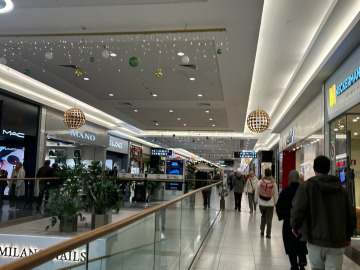
A large shopping center near my accommodation
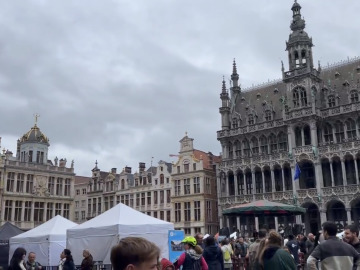
Grand Place on the third Sunday of September.A festival being held at the place.
There are two aspects of Belgian culture that left a strong impression on me.
The first is its beer culture. Staff members living in Belgium often proudly describe their country as a “beer kingdom,” and indeed, supermarkets offered an astonishing variety of beers unlike anything I had seen in Japan. The laboratory also kept dozens of bottles of beer on hand, which made me realize how deeply beer is rooted in everyday life.
The second is the strong awareness of language. Belgium has three official languages—French, Dutch, and German—and the language used depends on the region. On one occasion, when I greeted a shop staff member in French in a Dutch-speaking area, I was told that I should greet people in Dutch. This experience made me strongly aware of how important language is in Belgian society.
Future Goals After Overseas Experience
Through this overseas program, I deepened my understanding of my research field and realized the differences between research styles in Japan and abroad. Living outside Japan also helped me appreciate the strengths and supportive environment of Japanese research. In addition, I learned how to communicate and discuss effectively in English. In the future, I aim to communicate confidently in international settings and take an active role in teamwork and leadership.
Conclusion
Living abroad helped me realize how comfortable and supportive the research environment in Japan is. This is something that is easy to take for granted in daily life.
In the laboratory where I stayed, English ability itself was not a major concern. What mattered most was the willingness to communicate. Therefore, worrying too much about English ability should not stop people from studying abroad.
Finally, I would like to sincerely thank the SGU administrative support team and everyone who supported me during this program.