
The theme of the 2025 "Lectures by Experts" is "Communication." We will consider communication from the perspective of several experts. The sixth guest is a specialist in "media communication," Professor Toshie Takahashi (Faculty of Letters, Arts and Sciences). Professor has been researching social media and other digital media since the 2000s and has recently been involved in international collaborative research on the use of AI (artificial intelligence). She discussed the challenges and possibilities of communication between AI and humans.
What kind of "communication" is needed in the AI era?
In this rapidly changing age of AI, "dialogue" and "empathy" between humans will become even more important. While treating AI as a "partner in collaborative work," humans should focus on creative activities and building relationships with others.
INDEX
▼"Human-First Innovation" based on human dignity and happiness
▼The perspective of "digital well-being" is also important
▼The important thing is "self-creation" to reinvent yourself and society
"Human-First Innovation" based on human dignity and happiness
Professor Takahashi, what kind of research field is your specialty, "media communication"?
It is an interdisciplinary field of research that explores how technology shapes human behavior, thought, and the state of society. As the word "media" comes from the same root as "mediate," meaning "to act as an intermediary," it can also be said to be a field that examines the historical evolution of human communication methods. The media environment has undergone major changes, beginning with prehistoric murals and signal fires, moving through the era of carrier pigeons, and on to letterpress printing, telephones, television, the internet, and social media. And now, with the emergence of generative AI, such as ChatGPT, I believe we have entered a new era.
I have conducted fieldwork in Japan, Europe, the United States, and Asia for many years, researching how people receive information, connect with others, and shape themselves. Now that AI is directly involved in human creativity and decision-making, I believe it is important to understand the relationship between humanity and technology.
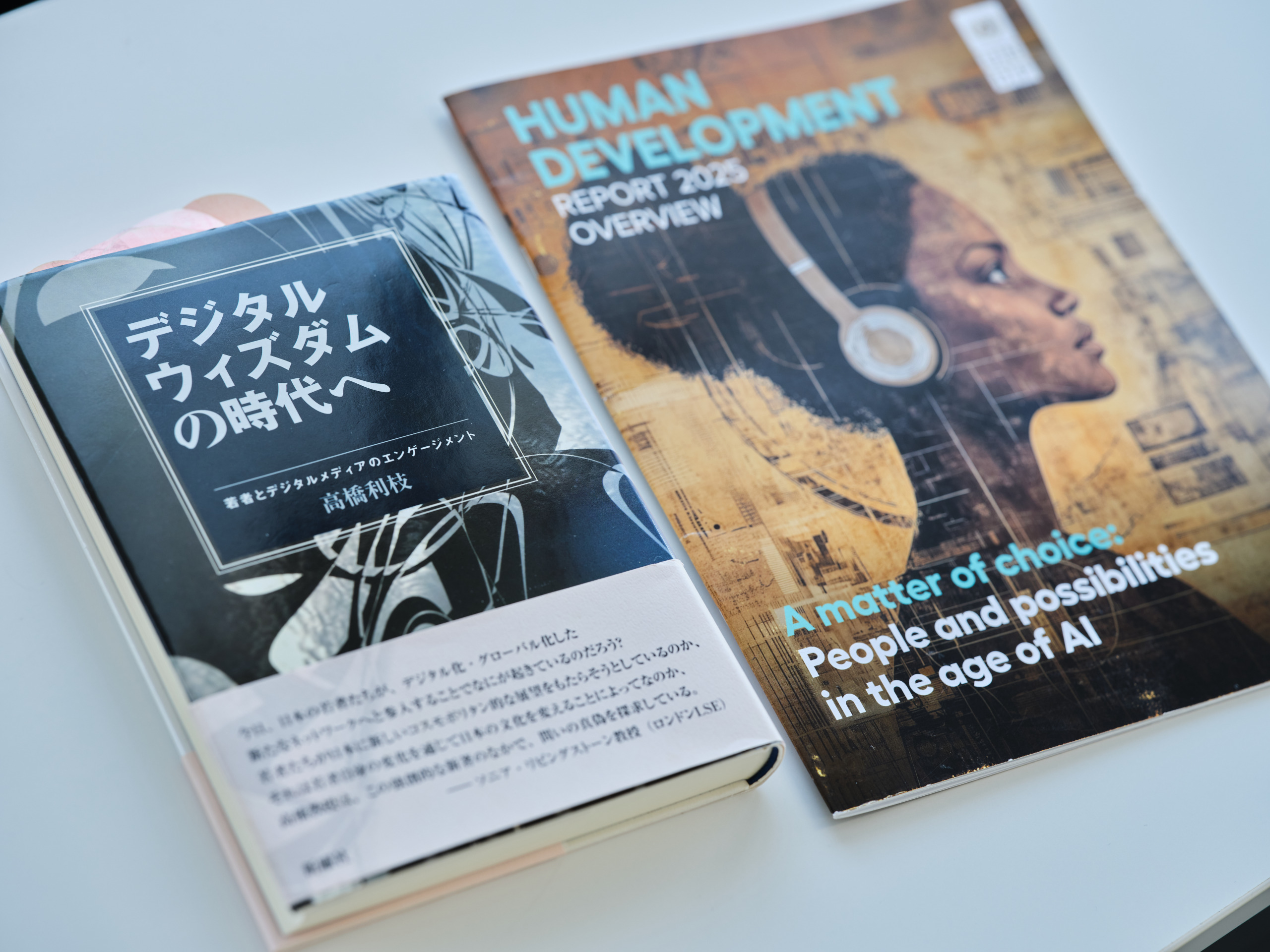
From the left: Professor Takahashi's book "Towards the Age of Digital Wisdom" (Shinyosha), and the United Nations Development Programme's "Human Development: Report 2025 Overview" (UNDP)
What does "human-first innovation" mean, the keyword in your AI research?
"Human-First Innovation" is a concept I have advocated through international collaborative research on AI. It has three pillars: "Human-First," "Cross-Discipline," and "Self-Creation."
The first, "human-first," refers to the idea of utilizing AI from the perspective of human dignity and happiness, rather than being technology-driven. Now, as the world becomes more closely interconnected, it is essential to view it as "technology for all of humanity," rather than for the benefit of individuals or a single country.
The second, "cross-discipline," refers to the approach of collaborating across the boundaries between the humanities and sciences to design an AI society that takes into account differences in culture and values. Problems that cannot be solved by technology alone increasingly require knowledge from the humanities and social sciences.
The third, "self-creation," refers to the ability to continue to reinvent oneself and society through experience in an era in which AI is dramatically changing the way we work and the structure of society. This concept was born from over 20 years of fieldwork on young people and the media, and I believe it is a core ability for turning change into opportunity in the age of AI.

The perspective of "digital well-being" is also important
What do you think about the current trends in social media and short videos?
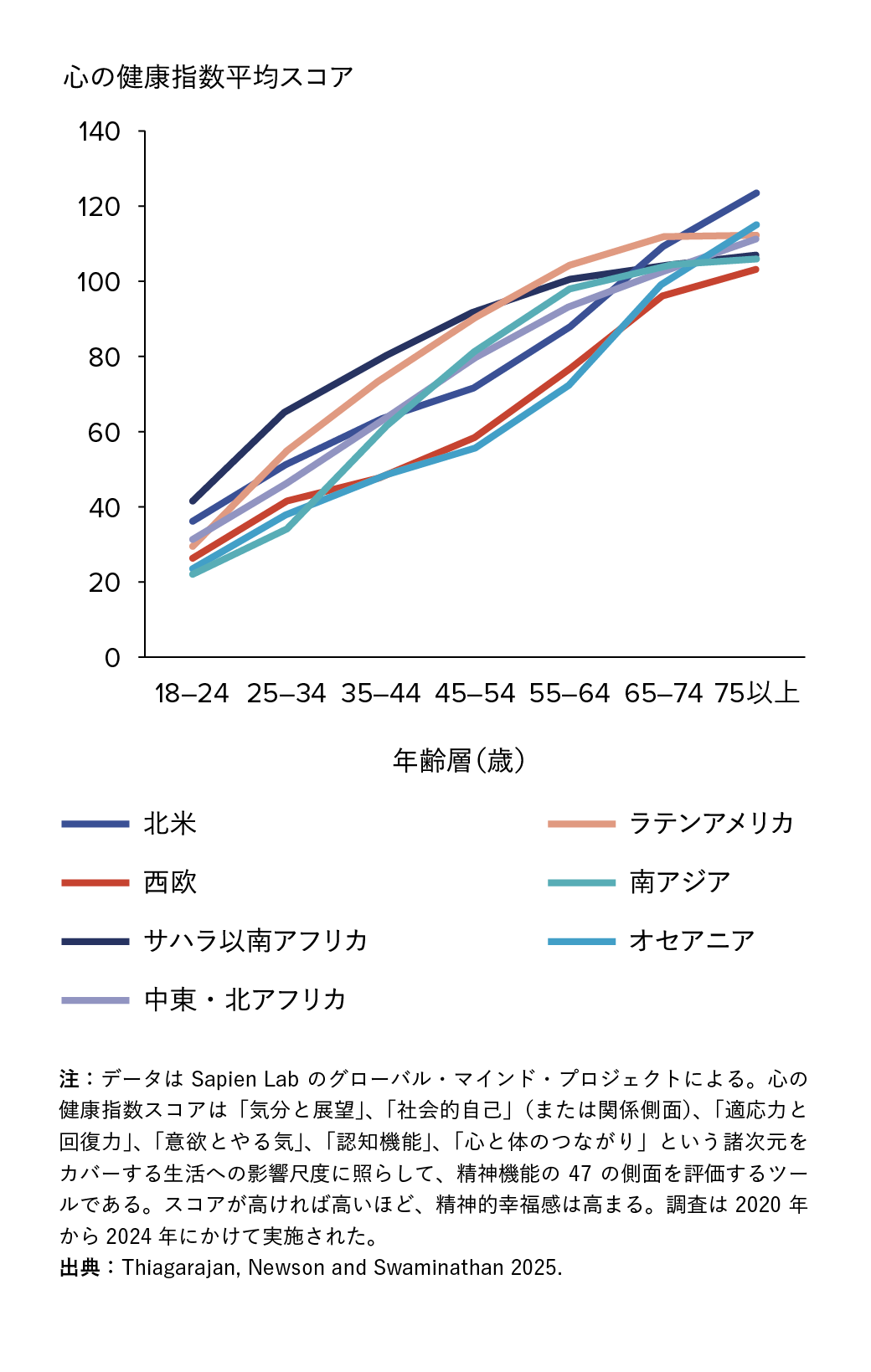
The higher the "average mental health index score" (vertical axis), the greater the sense of mental well-being (from the UNDP Human Development Report 2025)
While social media and short videos are convenient and fun, I often hear students say, "I ended up wasting three or four hours and regretting it." As a researcher, I'm concerned about the impact they have on young people's well-being, which is becoming a global issue. Survey data from the UNDP's (United Nations Development Programme) Human Development Report 2025 shows a sharp decline in the subjective satisfaction of young people. The "U-shaped curve of happiness" seen in the "Mental Health Index average score" in many countries 10 to 15 years ago has collapsed, and while older people have maintained a high level of satisfaction, only younger people have seen a decline. It has also been noted that young women, in particular, tend to have lower satisfaction than men.
This has been suggested to be correlated with the spread of smartphones, and is said to be due to factors such as comparison with others on social media, information overload, and poor quality sleep. This is why it is more important than ever to adopt a "digital well-being" perspective, where people actively use social media while protecting their mental health, rather than passively consuming it.
What challenges do you think there are in communication between AI and humans?
I believe there is great potential in communicating with AI. I have heard of cases where people suffering from depression gained confidence in communication through repeated conversations with generative AI and were able to return to their daily lives.
However, there are also many challenges. First, there is the issue of "dependence risk." It is dangerous to leave too much of our worries and decision-making to AI. There are concerns that people will become accustomed to instant answers and have fewer opportunities to think for themselves, leading to a "decline in autonomy." Another issue is the issue of "bias." With generative AI, the "bias" in the training data is directly reflected in the answers it gives.
Overall, it is important to view AI as a collaborative partner, not a replacement for humans. We need to take advantage of the power of AI while cultivating our own judgment and critical thinking.
Do you notice any differences between Japan and the West when it comes to the use of AI and social media?
In fact, there are cultural differences between Japan and the West in how people approach AI and social media. In the West, there is a surprisingly strong negative attitude toward the introduction of AI, and people tend to treat it as a foreign entity, like the movie "Terminator." In Japan, however, there is an overall positive attitude, likely due to the influence of "Doraemon" and "Astro Boy." This is thought to be influenced by social background factors, such as Japan's history of technological development since the war.
Meanwhile, in the West, social media functions as a tool to demonstrate a sense of contribution, showing that "I'm always there," whereas in Japan, there is a great deal of concern about "what others think of me," and people tend to use it with caution, trying to avoid causing trouble or sparking outrage. This could be attributed to the difference between Western "individualism" and Japanese "collectivism." It's not a question of which is better or worse, but rather I believe that each country's cultural values shape how people interact with technology (engagement).
What's important is "self-creation" to reinvent ourselves and society
How should the younger generation deal with AI?
We believe that what is required in the age of AI is not simply the ability to use it, but the following three skills: critical thinking, which allows you to verify AI information yourself; creativity, which allows you to create new value together with AI; and human empathy and ethics, which cannot be replaced by AI. Honing both technology and humanity will be essential to living independently in the coming age.
What's important is a sense of "self-creation," recreating yourself and society amid change. For example, imagine you're a taxi driver. What should you do when a fully autonomous driving society arrives? Instead of being pessimistic and thinking, "I'll be out of work tomorrow...," I think you should ask yourself, "What do I really want to do?" and use this as an opportunity to find a new purpose in life. In the age of generative AI, you could become a picture book author or film director tomorrow. I hope you will continue to build on the experience you've accumulated so far, cherish the things you like and the things you want to do, and take on new challenges that will enrich your life.

What does Professor Takahashi think about "communication" in the age of AI?
Communication in the age of AI will become more complex, with "people x people," "people x AI," and "AI x AI" overlapping. Going forward, we will enter an era in which AI will learn from the information it transmits and reproduce that information. We need to sharpen our critical thinking to understand the information society.
In such an era, "dialogue" and "empathy" between humans will become even more important. As more tasks are entrusted to AI, humans should focus on creative activities and building relationships with others. Now is the time to think about the skills that only humans can possess. This "human-centered" perspective is the foundation of "human-first innovation."
Finally, please give a message to Waseda students.
AI is simply a technology, but depending on how it is used, it can be a powerful tool that enhances our abilities and creativity. That is why it is important to have an approach that places humans, not AI, at the center.
"What kind of person do I want to be?" "What kind of society do I want to create?" Keep asking yourself these questions, think in your own words, and develop the ability to make choices. This will lead to "self-creation" that will enable you to survive in an era of change. I sincerely hope that Waseda University will produce global leaders who will pave the way for the AI society of the future.
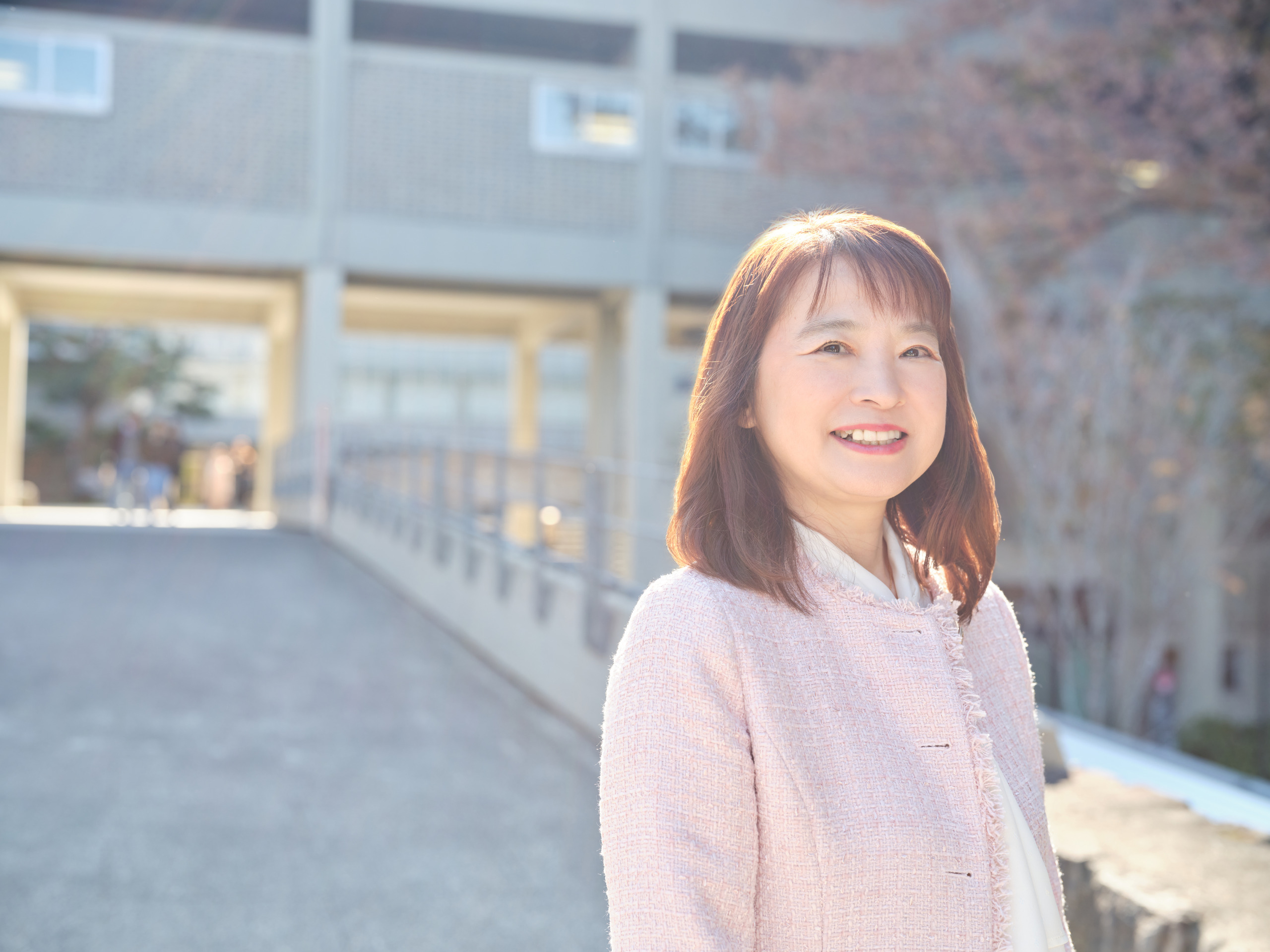
Toshie Takahashi
Professor Faculty of Letters, Arts and Sciences. Associate Fellow at the Cambridge University Future of Knowledge Institute. Completed a Master's Degree in Sociology at the Graduate School of Sociology, University of Tokyo. Completed a PhD in Social Sciences at the London School of Economics and Political Sciences (LSE) in the UK. Specializes in media and communication research. Analyzes artificial intelligence, robots, smartphones, social media, and other topics from a humanities and social science perspective. Conducts international collaborative research with the United Nations, Harvard University, Cambridge University, Stanford University, and others on the social impact of artificial intelligence and the utilization of robots.
Interview and text: Kenichi Marumo
Photo: Seiji Ishigaki



![[Save version] Map of the four main campuses](https://www.waseda.jp/inst/weekly/assets/uploads/2026/06/110d605cfac40346aad1d2df464a6586-940x705-1-1-610x457.jpg)