![]() |
![]() |
![]() |
![]() |
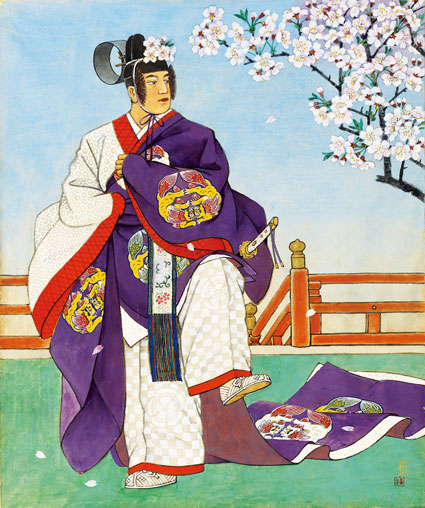
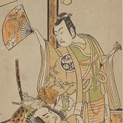
Rokusei Nakamura Utaemon (Nakamura Utaemon VI), the second son of Nakamura Utaemon V, was bom in Taisho 6 (1917). Utaemon VI made his debut when he was six; Nakamura Kotaro was his first stage name. After those stage names of Nakamura Fukusuke VI, Nakamura Shikan VI, he succeeded to the name of Rokusei Nakamura Utacmon in Showa 26 (1951).
Through his 80-year life as a leading Kabuki actor, Utaemon VI has made an extraordinary contribution to Kabuki in various aspects; he inherited traditions in performing classical numbers of Kabuki plays; he revalued some forgotten classical plays and revived them with a modern spirit; he presented some new plays. Today Utamon Vl is regarded as one of the best Kabuki actors after World War II, and his stage performances have won him a high reputation.
Another genre of Kabuki in which Utaemon VI has been involved is plays written by Tsubouchi Shoyo. Based on his father's achievement in this field,Utaemon VI has further improved the perfomancedrawing on his extraordinary talent as an actor. Utamon V was one of the advisors and conbibutors to the Waseda Theatre Museum in the early days of its history. Taking over his father's place, Utaemon VI has also been supporting the museum. In celebrating its 70th aniversary, the Waseda Performing Arts Museum opened the "Rokusei Nakamura Utaemon Commemorative Exhibition Room" to acknowledge Utaemon VI's contributions to Kabuki. Precious collections of the museum will be displayed in this room.
![]() |
![]() |
Since the time of Shakespeare until today, from London to Tokyo
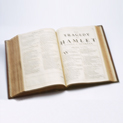
The works of Shakespeare, written in England in the 16th century, are staged all over the world. Those works not only deal with a wide range of subjects, but also are capable of taking various forms on the stage. Since they have an adaptability that allows them to change with the time and place, the works of Shakespeare have attracted many directors, actors and audiences.
In this section, we will introduce Shakespeare as an individual as well as his plays, and in addition we will take you to the world of Shakespeare by showing where and how his works have been performed.
![]() |
![]() |
Tsubouchi Shoyo (1859-1935) made a remarkable contribution to the field of literature, theatre, and education during the Meiji and Showa Eras. This Memorial Room was designed as a royal suite, which also used by Shoyo when he visited the museum. The room was based on the interior design practice of the Elizabethan Era, and the ceiling was decorated with sheep, which was Shoyo's sign in Chinese astrology. The bookshelves contained Western books which Shoyo used to translate Shakespeare's works. His various achievements, including his books and manuscripts, are exhibited here, and his personal collection is displayed.
![]() |
![]() |
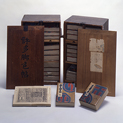
Japanese culture contains a wealth of traditional performing arts. Not only stage performing arts such as Bugaku, Noh, Kabuki, and Joruri but also folk performing arts are bequeathed from the past and play important roles in the study of the history of the present-day performing arts. It is, in fact, important to keep in mind the intercornnections between the two genres. For example, some of the stage performing arts have their roots in folk performing arts, and some were transformed into folk performing arts over the generations. It is also the case that performing arts which were once popular eventually gave way to the folk performing arts of today. Here are presented some documents related to folk performing arts such as Kagura, Dengaku, Huryu, and also some photographs of traditional festivals and performing arts of Japan.
![]() |
![]() |
The age of Bugaku Cultural exchange between ancient Japan and China was very active. Buddhism came to Japan in the middle of the sixth century, which was one of the events that had the greatest influence on Japanese history. In the seventh century when the cultural products of Asuka period flourished, the Court of Yamato patronised the musical entertainments from abroad such as Gigaku, Sangaku and Bugaku. The musical entertainments were popular especially in the Nara period. People also enjoyed several Japanese originated dance and music entertairment like Azuma-Asobi, Kume-Mai, Kishi-Mai, Tatefushi-Mai, Kuzu-Mai, Yamato-Mai, Hayato-Mai and so on. These were performed for various clan families until the Court of Yamato united the country. Then those entertainments were also performed in the Court ceremonies with foreign musical accompaniment. We would like to introduce you to the world of this ancient international entertairment.
![]() |
![]() |
In the Middle Ages, when the Samurai rose to the ruling position of the country, new types of entertainment were developed. Among the folk entertainment in the previous Heian era, Sarugaku and Dengaku were under the patronage of shrines and were played in rituals. Noh, a genre involving masks specific to Japan, was established with the support from the new ruling class but gained popularity among the masses as well. Noh introduced its story-based style from the developing narrative ballad, and aimed at quiet elegance and grace as its ideal of beauty. Ennen were performed very often at shrines. Kagura was disseminated all over Japan by Buddhist disciplinants.Matsubayashi and Nembutsu odori grew out of the festival music, one of whose representatives is Giongoqoe. Other types of entertainment, such as Heikyoku, Kusemai, Kouwakamai, Sekkyo, Houka, Hachitataki, and Senzumanzai, also appeared in this era. We hope you will enjoy the various kinds of mediaeval entertainment here.
![]() |
![]() |
New forms of public entertainment emerged during the 'Kinsei' period (the Edo period), the transition period from the age of samurai to that of peace. Kabuki and Ningyo Joruri are prime examples of the theatrical art of this period. Kabuki fitst appeared when a woman called 'Okuni' from the province of Izumo performed Kabuki Odori (Kabuki dances) in Kyoto in 1603. Joruri had existed as a story-telling genre since the late Muromachi period. It was combined with the then-new musical instrument, Shamisen, and with puppets called Ebisukaki, and formed a new style of theatrical art called Ningyo Joruri. Both artistic forms, Kabuki and Ningyo Joruri, had developed in the areas centring around three cities: Kyoto, Osaka and Edo. Theatres were built in these areas, which had not seen in other forms of theatrical art. The environment for people to visit and see the stage as it is today had been established. Enjoy yourself in the world of the theatrical art of 'Kinsei.'
![]() |
![]() |
The modern times for Japanese drama began with the rapid incorporation of European culture. Dramas satirising the politics and social conditions at that time captured people's heart, and this led to the emergence of Shimpa-Geki, which played a lot of dramas that were adapted from original European dramas by switching the settings of the stories to Japan. In the late Meiji period, a theatrical refom movement began, which was influenced by Bungei Kyokai's and Jiyugekijyo's translated versions of Shakespeare's and Ibsen's works. After these European-influenced movements, various schools of drama, such as Shimpa, Shingeki, Shinkokugeki (New National Theatre), the comedy, and the light comedy, flourished between the Taisho period and the early Showa period. hg World War Ⅱ, theatrical performances were controlled by the government, but after that they regained freedom, which gave rise to new kinds of theatrical arts; the musical, the underground, and dance. Here you will see how those kinds of drama developed.
![]() |
![]() |
Today we can see various kinds of plays in Japan. The primary branches are comprised of the typical classic plays such as Kabuki, Bunraku, Noh and Kyogen, the so-called business plays presented at big theatres with capital provided by production companies such as Shochiku and Toho, Shingeki presented by troupes such as Bungakuza, Haouiiza, Subaru, En and Shiki, small theatres which constitute various new modes of modern theatre after the late 1960s. They are currently centred around big cities like Tokyo, but local drama has been steadily supported. Theatres and halls have been constructed under the lead of municipal governments, with many drama festivals held periodically. Furthermore, these local theatres have become increasingly successful. Here we present material from these branches of modem Japanese theatre, as well as information provided by the troupes and theatres. We hope you enjoy our exhibit.
![]() |
![]() |